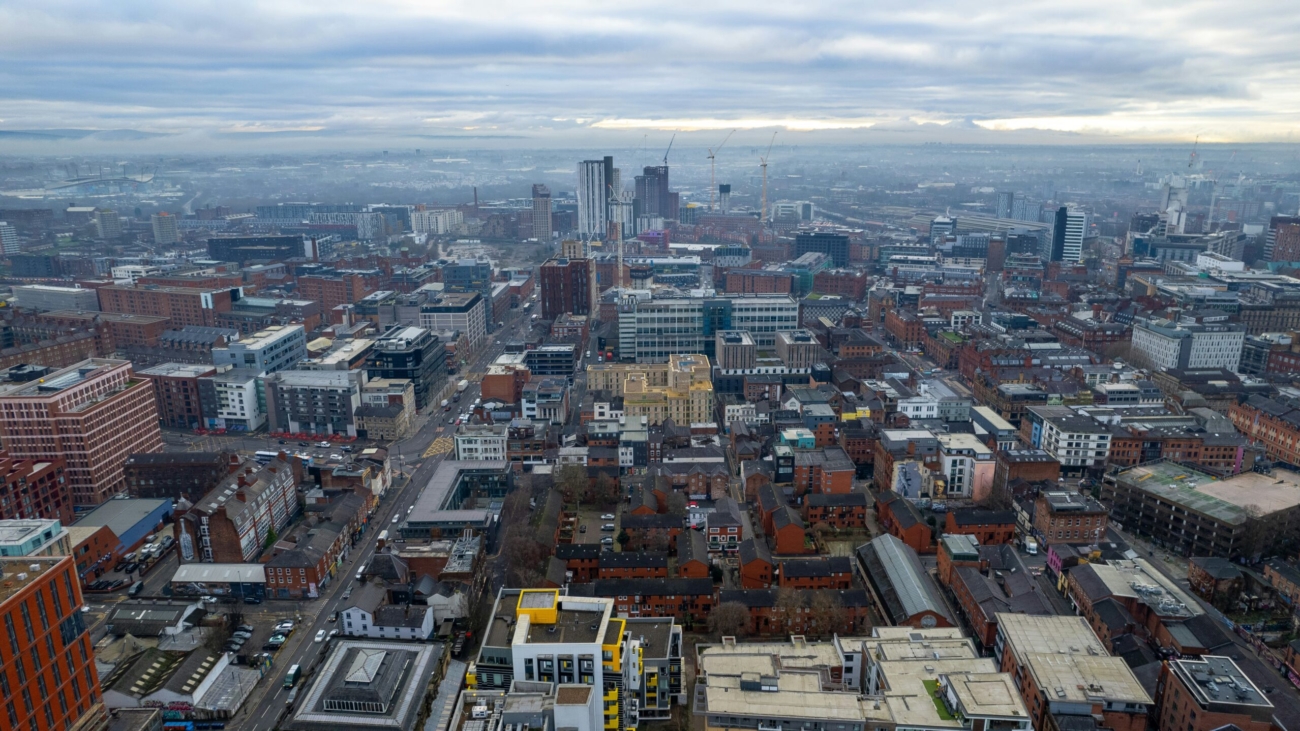
Manchester and Greater Manchester have become major centres for technology and digital growth. Discover how local businesses can use better websites, AI, automation, CRM, cloud technology and cybersecurity to reduce costs, improve productivity and compete for the future.
Manchester has always been a city that understands change. From its industrial heritage to its modern position as one of the UK’s most important regional economies, Manchester has repeatedly adapted as technology has transformed the way people live and work.
Today, another major transformation is underway.
This time, it is digital.
Artificial intelligence, automation, cloud computing, advanced websites, CRM systems, cybersecurity and data analytics are changing how businesses operate at remarkable speed.
For companies across Manchester and Greater Manchester, this creates both an opportunity and a challenge.
The opportunity is enormous. Technology that was once available mainly to large corporations is increasingly accessible to small and medium-sized businesses.
The challenge is equally important:
Businesses that modernise can become faster, leaner and more competitive. Those that wait may find the gap increasingly difficult to close.
At Hivebyte Technology Ltd, we believe Manchester businesses should not think about technology simply as an IT expense.
They should think about what it can do for the business.
Greater Manchester Is Much More Than Manchester City Centre
When people outside the region hear “Manchester business”, they often think primarily about the city centre.
But the Greater Manchester economy stretches much further.
It includes businesses operating across Bolton, Bury, Oldham, Rochdale, Salford, Stockport, Tameside, Trafford and Wigan, alongside Manchester itself.
Across these areas are manufacturers, construction companies, professional services firms, retailers, logistics businesses, healthcare providers, hospitality companies, property businesses, trades, startups and thousands of SMEs.
Their industries may be very different, but many face remarkably similar problems.
Rising costs.
Pressure on margins.
Time-consuming administration.
Difficulty finding skilled employees.
Increasing customer expectations.
More competition online.
Disconnected systems.
Cybersecurity concerns.
And the constant pressure to accomplish more without allowing costs to grow at the same rate.
This is precisely where technology can make a difference.
Manchester Has Reinvented Itself Before
Manchester’s relationship with technology is not new.
The city became internationally significant during the Industrial Revolution because businesses adopted new machinery, manufacturing processes and infrastructure.
Those technologies transformed productivity.
Today’s transformation looks very different, but the underlying business principle is familiar.
Companies gain an advantage when they find better ways to produce, communicate, sell and operate.
The modern equivalents are software, automation, AI, cloud infrastructure and data.
A Manchester business does not need a giant factory to experience a productivity revolution.
Sometimes it starts with fixing a process that employees repeat hundreds of times every month.
Technology Should Save Businesses Time
One of the biggest costs inside any business is time.
Consider a company where employees manually:
enter customer information into spreadsheets;
copy enquiries from emails;
prepare repetitive documents;
send appointment confirmations;
create reports;
update several different systems;
chase routine information;
and search through emails for customer history.
Each task may take only five or ten minutes.
That does not sound significant.
But multiply those minutes by hundreds of transactions, several employees and twelve months.
Suddenly the business is losing hundreds — potentially thousands — of working hours.
This is why automation can have such a significant impact.
You do not necessarily need people to work faster. You need to remove work they should not have to perform manually in the first place.
AI Will Become Part of Everyday Business
Artificial intelligence is receiving enormous attention, but businesses should look beyond the headlines.
The important question for a company in Manchester is not:
“How do we get AI?”
It is:
“Where could AI genuinely make this business more productive?”
AI can potentially help employees analyse information, summarise documents, produce initial drafts, organise data, identify patterns, support customer service and retrieve internal information more quickly.
As the technology develops, it will increasingly become integrated into the software businesses already use.
But there is an important warning.
AI cannot magically repair a badly organised company.
If customer information is spread across spreadsheets, processes are inconsistent and business systems do not communicate, adding AI on top can simply create another layer of technology.
Businesses need strong digital foundations first.
A Good Website Is Now Business Infrastructure
For many local businesses, the website remains one of the biggest missed opportunities.
A website should not simply say:
“This is who we are. Here is our telephone number.”
A modern business website can do significantly more.
Imagine a Stockport business receiving an enquiry through its website.
The customer’s information could automatically enter the CRM.
The appropriate salesperson could be notified.
The customer could immediately receive confirmation.
A follow-up could be scheduled.
Management could see where the lead originated.
The business could later measure whether that enquiry became a customer.
The website has now moved beyond advertising.
It has become part of the business operation.
For Manchester companies competing for customers online, that distinction matters.
Your Website Is Also Competing While You Sleep
A potential customer in Salford might search for your service at 10:30 at night.
Another customer in Bolton might compare three suppliers before breakfast.
A business owner in Trafford might research a new supplier on their phone between meetings.
Your office may be closed.
Your website is not.
This is why speed, mobile performance, clear content, strong calls to action and professional design matter.
Customers often form an opinion about a company before speaking to anybody who works there.
A business may provide an exceptional service, but if its digital presence looks outdated or difficult to use, potential customers may never discover that.
Better CRM Can Mean Fewer Lost Opportunities
Many SMEs do not necessarily have a shortage of leads.
Sometimes they have a shortage of follow-up.
An enquiry arrives.
Someone replies.
A quotation is sent.
The employee gets busy.
A week passes.
Nobody follows up.
The potential customer contacts another company.
That is not necessarily a marketing problem.
It is a process problem.
A properly configured CRM can help Manchester businesses track prospects, quotations, customer conversations and follow-ups.
Management gains visibility.
Employees know what needs attention.
And fewer opportunities depend entirely on somebody remembering what is sitting inside their inbox.
Technology Can Help Manchester SMEs Compete With Bigger Businesses
One of the most exciting developments in business technology is the increasing accessibility of sophisticated systems.
Twenty years ago, a small company could rarely compete technologically with a national organisation.
Large businesses had substantial IT departments, expensive software and custom-built systems.
That gap has narrowed.
Today, an SME can access professional cloud infrastructure, CRM platforms, automation, AI, sophisticated websites and advanced communications without needing the technology department of a multinational company.
This gives Greater Manchester SMEs an important opportunity.
A 15-person company can build systems that allow it to operate with the organisation and responsiveness previously associated with a much larger business.
Technology can make a small business feel much bigger to its customers.
Manufacturing Can Benefit Enormously
This is particularly relevant to Greater Manchester because the region retains an important manufacturing and engineering base.
Manufacturing businesses can sometimes think of digital transformation as something primarily affecting offices, technology companies or online retailers.
That would be a mistake.
Digital systems can potentially improve quoting, inventory visibility, scheduling, customer communication, reporting, documentation and operational monitoring.
Manufacturing businesses already understand productivity.
The next stage is increasingly about combining physical production with better digital information.
A machine may be efficient.
But if the quotation process surrounding it takes three days because information is being moved manually between departments, there is still an opportunity for improvement.
Construction and Trades Can Modernise Too
The same applies to construction and trade businesses.
Imagine enquiries automatically entering a central system.
Site information being accessible securely from mobile devices.
Quotations being tracked.
Customers receiving automated updates.
Photos and documents being organised against projects.
Invoices connecting more effectively with operational information.
Managers being able to understand the status of work without making ten telephone calls.
None of this needs to remove the human expertise that makes a construction or trade business valuable.
It removes administrative friction around that expertise.
Better Technology Can Help Control Costs
This matters particularly when businesses face challenging economic conditions.
Technology is sometimes postponed because management wants to reduce expenditure.
But outdated technology has a cost too.
Consider:
Employee time lost to manual administration.
Duplicate software subscriptions.
Errors caused by entering the same information repeatedly.
Sales opportunities that are not followed up.
Management time spent producing reports manually.
Website visitors who leave because the site performs poorly.
Downtime caused by unreliable systems.
These costs rarely appear on an invoice labelled “Cost of Outdated Technology.”
But they are real.
A business should therefore compare the cost of modernisation against the continuing cost of inefficiency, rather than comparing it against zero.
Cybersecurity Cannot Be an Afterthought
Greater dependence on technology also creates greater responsibility.
As companies move information into digital systems, cybersecurity becomes part of normal business risk management.
Customer information, employee records, email accounts, financial information and business systems all need appropriate protection.
Smaller companies sometimes assume cybercriminals are interested only in major corporations.
That is a dangerous assumption.
Security should therefore develop alongside digital transformation.
Strong authentication, sensible access controls, backups, updates, employee awareness and properly maintained systems should form part of the technology strategy from the beginning.
Data Can Help Businesses Make Better Decisions
Many business owners know their company extraordinarily well.
Experience and judgement remain valuable.
But good data can make that judgement even stronger.
Imagine being able to see clearly:
Which services generate the most enquiries?
Which areas of Greater Manchester produce the strongest customers?
Where do leads originate?
How quickly does the company respond?
Which quotations are being won?
Where are customers dropping out?
Which marketing campaigns actually produce revenue?
Which processes consume the most employee time?
These are not technology questions.
They are business questions that technology can help answer.
Manchester Businesses Should Not Buy Technology for the Sake of Technology
There is an important distinction here.
Digital transformation does not mean buying every new piece of software.
That can actually make a business less efficient.
Companies can end up with ten platforms that do not communicate, multiple subscriptions performing similar jobs and employees constantly moving information between systems.
Instead, businesses should begin with problems.
Where are we losing time?
Where are we losing money?
Where are customers experiencing frustration?
Where are sales opportunities disappearing?
Where are employees doing repetitive work?
Where does management lack visibility?
Then determine whether technology can solve those problems.
Start with the business problem. Then choose the technology.
Greater Manchester Has an Opportunity
Manchester has spent generations reinventing itself.
Its next transformation is already happening.
The businesses that benefit most will not necessarily be technology companies.
They will be ordinary companies that become better businesses because of technology.
A manufacturer in Rochdale.
A construction company in Salford.
An accountant in Stockport.
A retailer in Trafford.
A logistics company in Wigan.
A professional services company in Manchester.
A growing SME in Bolton.
Different businesses. Different customers. Different challenges.
But each can potentially use technology to become more efficient, responsive and competitive.
The Future Is Not About Replacing People
Technology conversations often become dominated by fears about replacing jobs.
For most SMEs, there is a much more immediate opportunity.
Stop making good employees waste time doing bad processes.
Let software move information between systems.
Let automation handle repetitive notifications.
Let the CRM remember when a customer needs following up.
Let reporting systems organise data.
Let AI assist with appropriate routine work.
Then let people concentrate on the things people do best:
relationships, judgement, creativity, negotiation, leadership, problem-solving and customer service.
That is where technology becomes genuinely valuable.
Final Thoughts: Manchester’s Next Business Revolution Will Be Digital
The Manchester region was transformed once by industrial technology.
The next transformation will increasingly be driven by digital technology.
AI, automation, modern websites, CRM systems, cloud infrastructure, cybersecurity and better use of data are not simply trends for large corporations.
They are becoming everyday business tools.
For companies across Manchester and Greater Manchester, the objective should not be to become a “technology business”.
It should be to become a stronger business using technology.
At Hivebyte Technology Ltd, that is how we believe digital transformation should work.
Understand the business.
Identify the inefficiencies.
Find where money and time are being lost.
Build the right technology around those problems.
Measure the improvement.
Then keep moving forward.
Because Manchester has never built its success by standing still.
And the businesses that embrace the next generation of technology could play a major part in writing Greater Manchester’s next chapter.