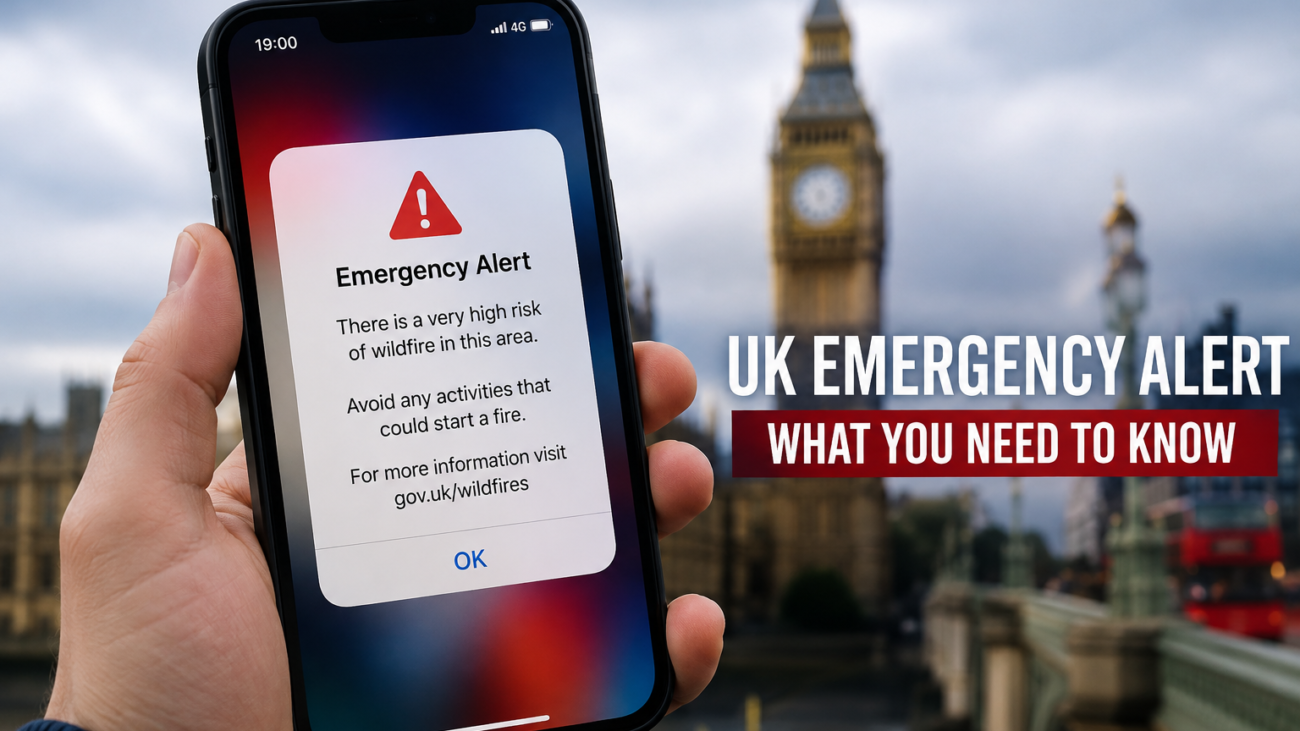
If your phone suddenly started making a loud siren sound yesterday, you weren’t the only one.
Millions of phones across England and Wales received a government emergency alert warning people about the very high risk of wildfires.
For some people it appeared while they were at home. For others it suddenly interrupted conversations, journeys or evenings out.
And because the alert can make a loud siren sound even when your phone is on silent, it’s fair to say it caught quite a few people by surprise.
But how did the government manage to send a message to millions of phones at once?
Did they need your phone number?
Can they track you?
And why did some people receive the alert while others didn’t?
The technology behind it is actually quite interesting.
What Was the UK Emergency Alert About?
The alert was issued because of the exceptionally high wildfire risk across parts of the country.
Britain has been experiencing extreme heat and very dry conditions, creating an environment where even a small fire can quickly become dangerous.
The message warned people not to undertake activities that could accidentally start a fire.
That included things such as disposable barbecues, campfires, firepits, garden incinerators and fireworks.
People were also reminded to report signs of fire immediately.
The warning came as firefighters across the country continued dealing with serious wildfires, some of which have damaged and destroyed homes.
But from a technology perspective, the interesting part was how quickly that warning appeared on millions of devices.
How Did the Government Send a Message to Millions of Phones?
You might assume the government simply sent everyone a giant text message.
That’s not actually how it works.
The UK’s Emergency Alerts system uses technology known as cell broadcasting.
Instead of sending a message to individual telephone numbers, an emergency alert can be broadcast through mobile phone masts in a particular area.
Think of it a little like a radio station.
The mobile mast broadcasts the alert and compatible phones connected within that area can receive it.
This means an alert could potentially be sent across a town, a region or a much larger part of the country.
And it can happen very quickly.
Does the Government Have Your Phone Number?
This is one of the biggest questions people have when an emergency alert suddenly appears.
The answer is that the Emergency Alerts system doesn’t need your phone number to send you the warning.
Because the alert is broadcast through mobile phone infrastructure, the system doesn’t work like an ordinary SMS message sent directly to your number.
Your device receives the broadcast when it is connected to a compatible mobile network in the affected area.
That distinction is important.
The government doesn’t need to create a giant list containing everybody’s mobile number before it can send an emergency warning.
Why Is the Alert So Loud?
The sound is deliberately difficult to ignore.
An emergency warning wouldn’t be particularly useful if it quietly appeared alongside your WhatsApp notifications.
Compatible phones can make a loud siren like noise and vibrate when an alert arrives.
This can happen even when the phone itself is set to silent.
The idea is simple.
If there is a serious danger nearby, authorities want people to notice the warning immediately.
It might be annoying when you’re sitting peacefully at home.
But imagine the alert was warning you about severe flooding, an approaching wildfire or another immediate danger.
Getting everyone’s attention suddenly makes much more sense.
Why Didn’t Some People Receive the Emergency Alert?
Interestingly, while millions of phones received the warning, some people reported receiving nothing.
There can be several reasons for this.
Your phone needs to be compatible with the Emergency Alerts system and connected to a supported mobile network.
A device might also miss an alert if it is switched off or in airplane mode when the warning is broadcast.
Network conditions and device settings can also play a role.
This explains why two people sitting near each other can sometimes have completely different experiences.
One phone starts screaming.
The other does absolutely nothing.
Can Emergency Alerts Track Your Location?
The system works differently from an app constantly monitoring your GPS position.
Emergency Alerts can be targeted geographically using mobile network infrastructure.
The alert is broadcast to compatible devices connected to mobile masts covering the relevant area.
That means authorities can warn people in an affected location without needing to know the identity of every person receiving the message.
This is one of the clever aspects of cell broadcast technology.
The network effectively says:
“Every compatible phone in this area needs to see this warning.”
It doesn’t need to individually message every person.
Why Not Just Send Everyone a Text?
Imagine trying to send an SMS to tens of millions of people during an emergency.
That’s an enormous number of individual messages.
Cell broadcasting is designed for exactly this type of situation.
One message can be transmitted to large numbers of compatible devices within an area at the same time.
It’s also useful because emergency warnings can be geographically targeted.
A serious flood in one part of Britain doesn’t necessarily require disturbing everybody in Scotland, Wales and England.
Authorities can target warnings towards the people who actually need the information.
Your Smartphone Is Becoming Part of Britain’s Emergency Infrastructure
This is perhaps the most interesting part of the story.
Most of us think of our phones as personal devices.
We use them for TikTok.
WhatsApp.
Banking.
Google Maps.
Taking photos.
Checking emails.
Ordering food.
But smartphones have quietly become part of national infrastructure too.
Almost everybody carries one.
They’re connected to mobile networks throughout the day.
And they can receive information almost instantly.
That makes smartphones an incredibly powerful tool during an emergency.
Instead of waiting for someone to see a television broadcast, hear something on the radio or notice a post on social media, an important warning can appear directly on the device sitting in their pocket.
What Happens During a Bigger Emergency?
The technology isn’t limited to wildfire warnings.
The UK Emergency Alerts system can potentially be used when there is a serious threat to life.
That could include situations involving severe flooding, extreme weather or other major emergencies.
And because alerts can be geographically targeted, the message people receive can relate directly to what’s happening around them.
Imagine a rapidly developing flood.
People within the affected area could receive instructions telling them what is happening and what action they need to take.
In situations where every minute matters, that could be incredibly valuable.
Technology You Hopefully Never Need
Most technology is designed to make life easier.
Emergency technology is slightly different.
The best outcome is that you rarely need it.
But when something serious happens, the infrastructure needs to already exist.
Mobile networks, smartphones and cell broadcasting have created a way of communicating with millions of people extremely quickly.
Yesterday’s alert gave millions of people a very noticeable demonstration of that technology.
For many, the first reaction was probably:
“Why is my phone making that noise?”
But behind that loud siren is a surprisingly clever communication system.
Your phone number isn’t required.
You don’t need to download a special app.
And the warning can reach huge numbers of people in seconds.
It’s a good example of technology doing something that isn’t particularly glamorous but could ultimately help save lives.
So the next time your phone suddenly starts making a noise you’ve never heard before, don’t immediately throw it across the room.
Take a look at the screen.
It might actually be important.
About Hivebyte Technology
At Hivebyte Technology, we love looking beyond the headline to understand how the technology around us actually works.
From websites and custom software to mobile technology, automation and emerging digital trends, we’ll continue covering the technology stories affecting people and businesses across the UK.