
Cyber Security 2026

UK Cyber Security in 2026: Is Your Business Really Prepared?

Cyber security is once again a major talking point across the UK. High-profile cyber incidents regularly remind businesses how dependent they have become on websites, email, cloud platforms, customer databases and other digital systems.

For small and medium-sized businesses, it can be tempting to think cyber attacks are primarily a problem for large corporations and government organisations.

They aren’t.

A business website, WordPress installation, e-commerce store or CRM can contain valuable information and provide an important route into a company’s wider digital operations. Protecting these systems should therefore be treated as an everyday business responsibility rather than something considered only after an incident.

Your Website Is Part of Your Business Infrastructure

A modern website does much more than display information.

It may collect customer enquiries, process orders, connect to payment providers, integrate with a CRM, manage bookings or hold customer accounts.

If that website becomes unavailable or compromised, the impact can quickly extend beyond the website itself.

Customers may be unable to contact you, orders could be interrupted, confidential information could be exposed and the reputation you’ve spent years building could be damaged.

That’s why website security needs to be considered alongside design, speed and search visibility.

Outdated Websites Can Create Unnecessary Risk

One of the simplest ways businesses can reduce their exposure is by keeping their websites properly maintained.

For a WordPress website, this includes regularly reviewing and updating:

  • WordPress itself
  • Themes
  • Plugins
  • PHP and hosting environments
  • User accounts and permissions
  • Security configurations
  • Backups

Updates aren’t simply about getting new features. They can also contain important security fixes.

A website that hasn’t been maintained for months or years can therefore become an unnecessary weak point in a company’s digital infrastructure.

Password Security Still Matters

Despite increasingly sophisticated technology, basic account security remains extremely important.

Businesses should avoid sharing passwords between employees, using the same password across multiple services or leaving accounts active when somebody no longer requires access.

Strong, unique passwords and multi-factor authentication should be used wherever appropriate.

Businesses should also regularly review who has administrator access to websites, hosting accounts, email systems and other important platforms.

Not everybody needs administrator privileges.

Giving people only the access they actually require can reduce risk if an individual account is ever compromised.

Backups Are Essential

Imagine arriving at work tomorrow and discovering your entire website has disappeared.

Could you restore it?

More importantly, when was your last usable backup?

A reliable backup strategy is one of the most important protections a business can have.

Backups should be created regularly and stored appropriately. Businesses should also understand how those backups would actually be restored.

Having a backup is useful.

Knowing that the backup works is considerably better.

Be Careful With Emails and Unexpected Requests

Technology isn’t always the easiest route into a business.

Sometimes people are.

Phishing attempts can be designed to look like legitimate messages from suppliers, colleagues, banks, hosting companies and familiar online services.

A message might ask somebody to reset a password, open an attachment, approve a payment or sign into an account.

Employees should be encouraged to stop and verify unusual requests rather than acting immediately.

A few seconds spent checking an unexpected email could prevent a much larger problem.

E-Commerce Businesses Have Even More to Consider

Security is particularly important for businesses operating online stores.

Customers are trusting the business every time they create an account, submit their details or make a purchase.

E-commerce businesses should therefore pay particular attention to software maintenance, payment integrations, administrator access, backups and monitoring.

Security can also affect customer confidence.

A professional-looking website means little if customers don’t feel comfortable using it.

Your CRM Needs Protecting Too

Websites aren’t the only systems businesses need to think about.

A CRM can contain customer names, contact information, conversations, sales opportunities, internal notes and other valuable business information.

Access should be properly controlled.

Former employees should not retain access, unnecessary administrator accounts should be removed, and businesses should periodically review which users can see or change sensitive information.

As more business operations become digital, protecting the systems behind the website becomes just as important as protecting the website itself.

What Should UK Businesses Do Now?

Cyber security doesn’t always require a dramatic technology overhaul.

Start with the fundamentals.

Review your website and software updates. Check your backups. Review administrator accounts. Strengthen passwords. Enable multi-factor authentication where appropriate. Remove access that is no longer required. Make sure employees understand the risks of suspicious emails and unexpected login requests.

Most importantly, don’t wait until something goes wrong before discovering how your digital systems are managed.

Security Is an Ongoing Process

There is no single button that makes a business permanently secure.

Technology changes.

Websites change.

New vulnerabilities are discovered.

Employees join and leave.

New software gets installed.

That means security and maintenance need to be ongoing processes.

A website that was properly secured when it launched several years ago shouldn’t automatically be assumed to be adequately protected today.

Regular maintenance gives businesses an opportunity to identify problems earlier, keep software current and ensure important systems continue operating as expected.

Is Your Business Website Being Properly Maintained?

At Hivebyte Technology Ltd, we build and support websites, e-commerce platforms and CRM solutions for businesses.

We believe a business website shouldn’t simply look professional. The technology behind it should also be properly maintained, monitored and supported.

If you’re unsure when your website was last updated, whether your backups are working or who currently has administrator access, now is a good time to review it.

Protect the technology your business depends on.

Hivebyte Technology Ltd
Websites • E-Commerce • CRM • Maintenance & Support
 
 
Support Centre

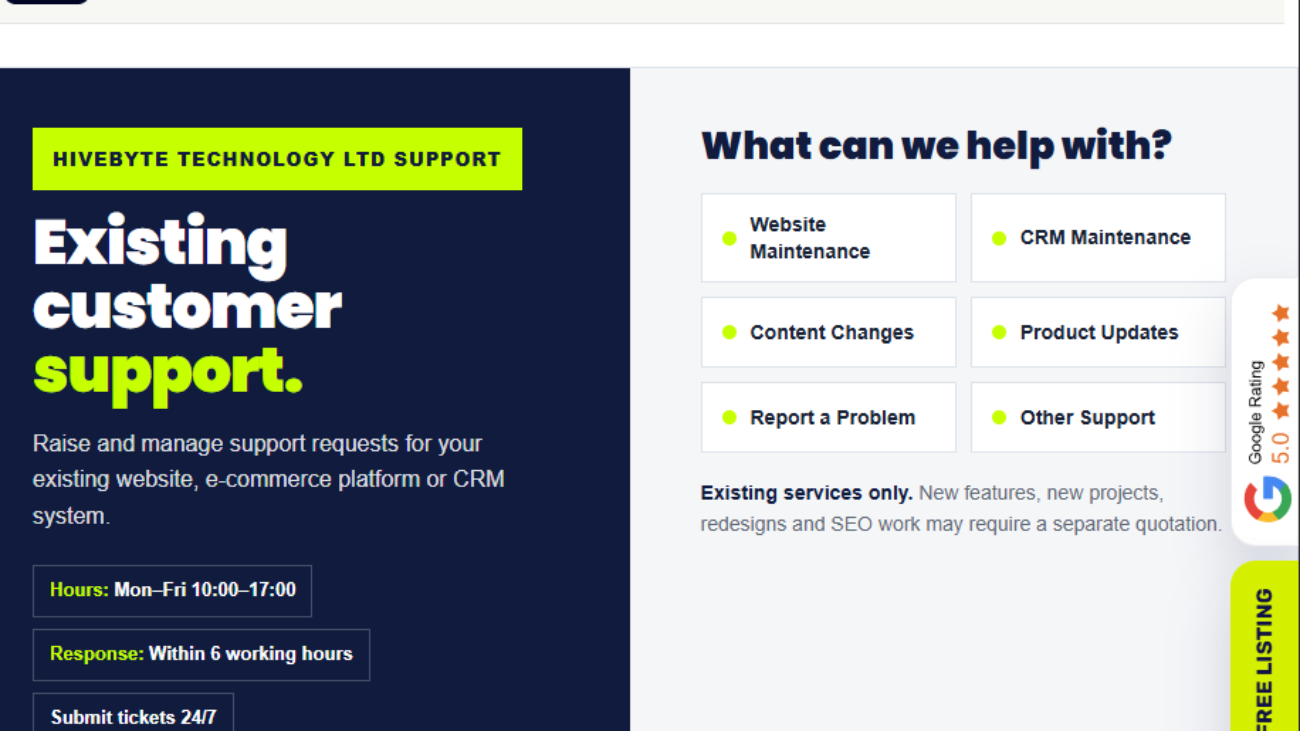
Introducing the New Hivebyte Technology Support Center

Introducing the New Hivebyte Technology Support Center

A Better Support Experience, Built Around Your Journey

At Hivebyte Technology, we believe great technology should be backed by great support.

That’s why we’re excited to announce the launch of the new Hivebyte Technology Support Center — an online destination designed to make getting help simpler, faster, and more focused on your success.

Our new Support Center is more than a place to find answers. It’s part of our commitment to creating a better customer journey, from your first interaction with Hivebyte Technology through implementation, everyday use, support, and long-term success.

Support That Starts With the Customer

Every customer journey is different. Some customers need a quick answer. Others need guidance through a technical challenge, help understanding a service, or support with their next step.

The new Hivebyte Technology Support Center is designed around those different needs.

Customers can use the Support Center to:

  • Find answers to common questions

  • Access helpful guides and support resources

  • Get assistance with technical issues

  • Learn more about Hivebyte Technology services

  • Navigate solutions more easily

  • Connect with our support team when additional help is needed

Our goal is simple: make it easier for customers to get the right support at the right moment.

From Customer Support to Customer Success

We see support as more than solving problems.

Customer success means helping people get lasting value from the technology and services they use. That requires listening to customers, understanding where challenges occur and continually improving the experience.

The new Support Center gives us a stronger foundation for doing exactly that.

As the platform grows, we plan to continue developing resources based on customer questions, feedback and real support experiences. This will help us create a knowledge base that becomes more useful with every stage of the customer journey.

A More Connected Online Experience

The launch of our Support Center is also an important step in the continued development of Hivebyte Technology’s online customer experience.

We want customers to have a clear journey from discovery → onboarding → support → success.

By bringing helpful information and support resources together online, we can reduce unnecessary friction while making it easier for customers to move forward with confidence.

Built to Keep Improving

This is just the beginning.

We’ll continue improving the Hivebyte Technology Support Center with new guides, resources, frequently asked questions and customer-focused content.

Most importantly, we’ll use customer feedback to help shape what comes next.

Because technology may power the solution, but customer success is what gives it purpose.

Welcome to the Hivebyte Technology Support Center

Whether you’re looking for a quick answer, need technical assistance or want to get more from your Hivebyte Technology services, our new Support Center is here to help.

Explore. Learn. Get support. Succeed.

Welcome to a better support journey with Hivebyte Technology.

sss

What If ChatGPT Suddenly Stopped Working in the UK?

Imagine arriving at work tomorrow morning, opening your laptop and discovering that some of the world’s most powerful AI tools are no longer available in Britain.

No warning.

No access.

And no obvious alternative.

For most people, that might sound like a minor inconvenience.

But for thousands of UK businesses that are beginning to build artificial intelligence into their everyday operations, it could be a much bigger problem.

And remarkably, this is now something the UK government is reportedly thinking about.

Why Is the UK Worried About AI Access?

Britain has become an enthusiastic adopter of artificial intelligence.

Companies are using AI to write software, analyse information, process documents, answer customer questions and automate repetitive work.

But there’s a problem.

Many of the most powerful AI models aren’t British.

They are developed by companies overseas.

That means a growing part of Britain’s digital economy could become dependent on technology the UK doesn’t ultimately control.

According to reports this week, the government is examining the economic and security consequences of Britain potentially losing access to leading AI models.

It sounds dramatic.

But it raises a very important question.

Are we becoming too dependent on AI technology controlled by other countries and companies?

AI Has Quietly Become Part of Everyday Business

It wasn’t long ago that ChatGPT felt like an interesting experiment.

People asked it silly questions.

Students discovered it could help with homework.

Businesses experimented with writing emails and social media posts.

Things have moved incredibly quickly since then.

AI is now becoming part of real business infrastructure.

Developers use AI to help write and review code.

Marketing teams use it for research and content.

Customer service teams use AI assistants.

Accountants can use intelligent systems to analyse documents.

Companies are connecting AI directly to websites, CRMs and internal software.

For some businesses, AI isn’t an experiment anymore.

It’s becoming part of how the company operates.

And that’s why losing access would matter.

Imagine Running a Business That Depends on AI

Consider a company that has automated its customer enquiry process.

Someone submits a form through the website.

AI reads the enquiry.

It identifies what the customer needs.

It updates the CRM.

It prepares information for the sales team.

It might even generate a suggested response.

Everything happens automatically.

Now imagine the AI model behind that system suddenly becomes unavailable.

The automation stops.

Staff have to return to doing everything manually.

Customers wait longer.

The business has to find another provider and rebuild parts of its system.

That’s not simply losing access to a chatbot.

That’s losing part of your technology infrastructure.

The UK Has a Technology Dependency Problem

This isn’t unique to artificial intelligence.

Modern businesses already depend heavily on technology controlled by a relatively small number of global companies.

Think about how much of the internet depends on cloud computing.

Or how many businesses depend on Microsoft 365.

Google Workspace.

Amazon Web Services.

Apple and Android smartphones.

Stripe and other payment systems.

Now AI is joining that list.

But AI could become particularly important because it may eventually sit behind hundreds of different business processes.

A company might not even realise how dependent it has become until something stops working.

What Is AI Sovereignty?

You’ll probably hear the phrase AI sovereignty much more over the next few years.

It sounds complicated, but the idea is fairly simple.

A country wants enough control over important artificial intelligence technology that it isn’t completely dependent on somebody else.

That could mean having its own computing infrastructure.

Its own data centres.

Its own AI research.

Its own models.

Its own chips or reliable access to them.

And enough domestic expertise to build and operate these systems.

For Britain, this is becoming both an economic and national security question.

Britain Is Spending Billions on the Problem

The UK isn’t ignoring the issue.

Britain is investing heavily in computing infrastructure and artificial intelligence.

The government has committed significant funding towards AI hardware and domestic capabilities as it attempts to strengthen Britain’s position in the global AI race.

And there’s a good reason for that.

AI is beginning to show up in the wider UK economy.

Recent economic figures showed strong growth in technology industries associated with AI, including computer programming and consultancy.

So the stakes are getting higher.

If AI becomes an important driver of Britain’s economy, reliable access to the technology becomes increasingly important too.

Could Britain Build Its Own ChatGPT?

Technically, Britain has world class researchers, universities and technology companies.

But building AI at the very highest level is enormously expensive.

The biggest models require huge quantities of computing power.

That means enormous data centres filled with specialist chips.

It means electricity.

Engineers.

Researchers.

Training data.

Networking infrastructure.

And billions of pounds in investment.

This is why only a relatively small number of organisations can currently compete at the frontier.

Britain doesn’t necessarily need to recreate every American AI company.

But it may decide that having more domestic capability is strategically important.

This Matters to Small Businesses Too

It’s easy to think this is just a government problem.

It isn’t.

If your business is starting to use AI, you should understand what happens when the technology you’re relying on disappears.

This is the same principle businesses should already apply to websites and cloud software.

Don’t build critical infrastructure with no backup plan.

If an AI provider changes its pricing, changes its rules or removes a service, what happens?

Can you switch providers?

Is your business data portable?

Does your software only work with one AI model?

Could staff temporarily complete the process manually?

These questions sound boring.

Until something stops working.

Then they become extremely important.

The Smart Approach Is Not to Depend on One AI

Businesses don’t need to stop using AI because of this risk.

Quite the opposite.

AI is becoming too useful to ignore.

But companies should think carefully about how their systems are designed.

Where possible, software can be built so that the AI provider isn’t permanently locked into every part of the system.

Think of it like changing your broadband provider.

You don’t want to rebuild your entire office every time you switch.

Good software architecture can make it easier to change technology as the market evolves.

And the AI market is evolving incredibly quickly.

Today’s best model may not be the best model six months from now.

AI Is Becoming Infrastructure

That’s the bigger story here.

Artificial intelligence is beginning to look less like another piece of software and more like infrastructure.

Electricity is infrastructure.

Broadband is infrastructure.

Cloud computing is infrastructure.

AI could eventually sit alongside them.

Businesses may simply expect intelligent systems to be available whenever they’re needed.

Once that happens, who controls the technology becomes incredibly important.

And that is why the UK government is paying attention.

So, Could ChatGPT Really Disappear From Britain?

There’s no indication that ChatGPT is simply about to vanish from UK phones and computers tomorrow.

The point isn’t that people should panic.

The interesting part is that governments are now seriously considering what dependence on foreign AI could mean.

Only a few years ago, that question would have sounded ridiculous.

Today, AI is becoming important enough that access to powerful models can affect businesses, cybersecurity, productivity and potentially an entire country’s economy.

That’s an extraordinary change in a very short period of time.

The Next Technology Race Has Already Started

The internet transformed business because every company eventually needed to become digital.

AI could create a similar shift.

The countries that control the infrastructure, computing power and technology behind artificial intelligence could have a major advantage.

Britain clearly wants to be one of them.

For UK businesses, the lesson is simpler.

Use AI.

Experiment with it.

Automate the things that genuinely waste your time.

But understand what your business is becoming dependent on.

Because the biggest technology story of the next decade may not simply be what AI can do.

It may be who controls it.

About Hivebyte Technology

At Hivebyte Technology, we follow the technology changes that actually matter to UK businesses.

From websites and custom software to CRM systems, automation and emerging technology, we believe the best technology should solve real problems rather than simply follow the latest hype.

And as AI becomes part of everyday business infrastructure, understanding where that technology comes from may become just as important as understanding what it can do.

UK emergency alert

Why Did Your Phone Make That Loud Noise? The UK Emergency Alert Explained

If your phone suddenly started making a loud siren sound yesterday, you weren’t the only one.

Millions of phones across England and Wales received a government emergency alert warning people about the very high risk of wildfires.

For some people it appeared while they were at home. For others it suddenly interrupted conversations, journeys or evenings out.

And because the alert can make a loud siren sound even when your phone is on silent, it’s fair to say it caught quite a few people by surprise.

But how did the government manage to send a message to millions of phones at once?

Did they need your phone number?

Can they track you?

And why did some people receive the alert while others didn’t?

The technology behind it is actually quite interesting.

What Was the UK Emergency Alert About?

The alert was issued because of the exceptionally high wildfire risk across parts of the country.

Britain has been experiencing extreme heat and very dry conditions, creating an environment where even a small fire can quickly become dangerous.

The message warned people not to undertake activities that could accidentally start a fire.

That included things such as disposable barbecues, campfires, firepits, garden incinerators and fireworks.

People were also reminded to report signs of fire immediately.

The warning came as firefighters across the country continued dealing with serious wildfires, some of which have damaged and destroyed homes.

But from a technology perspective, the interesting part was how quickly that warning appeared on millions of devices.

How Did the Government Send a Message to Millions of Phones?

You might assume the government simply sent everyone a giant text message.

That’s not actually how it works.

The UK’s Emergency Alerts system uses technology known as cell broadcasting.

Instead of sending a message to individual telephone numbers, an emergency alert can be broadcast through mobile phone masts in a particular area.

Think of it a little like a radio station.

The mobile mast broadcasts the alert and compatible phones connected within that area can receive it.

This means an alert could potentially be sent across a town, a region or a much larger part of the country.

And it can happen very quickly.

Does the Government Have Your Phone Number?

This is one of the biggest questions people have when an emergency alert suddenly appears.

The answer is that the Emergency Alerts system doesn’t need your phone number to send you the warning.

Because the alert is broadcast through mobile phone infrastructure, the system doesn’t work like an ordinary SMS message sent directly to your number.

Your device receives the broadcast when it is connected to a compatible mobile network in the affected area.

That distinction is important.

The government doesn’t need to create a giant list containing everybody’s mobile number before it can send an emergency warning.

Why Is the Alert So Loud?

The sound is deliberately difficult to ignore.

An emergency warning wouldn’t be particularly useful if it quietly appeared alongside your WhatsApp notifications.

Compatible phones can make a loud siren like noise and vibrate when an alert arrives.

This can happen even when the phone itself is set to silent.

The idea is simple.

If there is a serious danger nearby, authorities want people to notice the warning immediately.

It might be annoying when you’re sitting peacefully at home.

But imagine the alert was warning you about severe flooding, an approaching wildfire or another immediate danger.

Getting everyone’s attention suddenly makes much more sense.

Why Didn’t Some People Receive the Emergency Alert?

Interestingly, while millions of phones received the warning, some people reported receiving nothing.

There can be several reasons for this.

Your phone needs to be compatible with the Emergency Alerts system and connected to a supported mobile network.

A device might also miss an alert if it is switched off or in airplane mode when the warning is broadcast.

Network conditions and device settings can also play a role.

This explains why two people sitting near each other can sometimes have completely different experiences.

One phone starts screaming.

The other does absolutely nothing.

Can Emergency Alerts Track Your Location?

The system works differently from an app constantly monitoring your GPS position.

Emergency Alerts can be targeted geographically using mobile network infrastructure.

The alert is broadcast to compatible devices connected to mobile masts covering the relevant area.

That means authorities can warn people in an affected location without needing to know the identity of every person receiving the message.

This is one of the clever aspects of cell broadcast technology.

The network effectively says:

“Every compatible phone in this area needs to see this warning.”

It doesn’t need to individually message every person.

Why Not Just Send Everyone a Text?

Imagine trying to send an SMS to tens of millions of people during an emergency.

That’s an enormous number of individual messages.

Cell broadcasting is designed for exactly this type of situation.

One message can be transmitted to large numbers of compatible devices within an area at the same time.

It’s also useful because emergency warnings can be geographically targeted.

A serious flood in one part of Britain doesn’t necessarily require disturbing everybody in Scotland, Wales and England.

Authorities can target warnings towards the people who actually need the information.

Your Smartphone Is Becoming Part of Britain’s Emergency Infrastructure

This is perhaps the most interesting part of the story.

Most of us think of our phones as personal devices.

We use them for TikTok.

WhatsApp.

Banking.

Google Maps.

Taking photos.

Checking emails.

Ordering food.

But smartphones have quietly become part of national infrastructure too.

Almost everybody carries one.

They’re connected to mobile networks throughout the day.

And they can receive information almost instantly.

That makes smartphones an incredibly powerful tool during an emergency.

Instead of waiting for someone to see a television broadcast, hear something on the radio or notice a post on social media, an important warning can appear directly on the device sitting in their pocket.

What Happens During a Bigger Emergency?

The technology isn’t limited to wildfire warnings.

The UK Emergency Alerts system can potentially be used when there is a serious threat to life.

That could include situations involving severe flooding, extreme weather or other major emergencies.

And because alerts can be geographically targeted, the message people receive can relate directly to what’s happening around them.

Imagine a rapidly developing flood.

People within the affected area could receive instructions telling them what is happening and what action they need to take.

In situations where every minute matters, that could be incredibly valuable.

Technology You Hopefully Never Need

Most technology is designed to make life easier.

Emergency technology is slightly different.

The best outcome is that you rarely need it.

But when something serious happens, the infrastructure needs to already exist.

Mobile networks, smartphones and cell broadcasting have created a way of communicating with millions of people extremely quickly.

Yesterday’s alert gave millions of people a very noticeable demonstration of that technology.

For many, the first reaction was probably:

“Why is my phone making that noise?”

But behind that loud siren is a surprisingly clever communication system.

Your phone number isn’t required.

You don’t need to download a special app.

And the warning can reach huge numbers of people in seconds.

It’s a good example of technology doing something that isn’t particularly glamorous but could ultimately help save lives.

So the next time your phone suddenly starts making a noise you’ve never heard before, don’t immediately throw it across the room.

Take a look at the screen.

It might actually be important.

About Hivebyte Technology

At Hivebyte Technology, we love looking beyond the headline to understand how the technology around us actually works.

From websites and custom software to mobile technology, automation and emerging digital trends, we’ll continue covering the technology stories affecting people and businesses across the UK.

a0701fe6-88ef-45af-86c8-cbfc7c4bdb1f

The UK AI Boom Is Becoming Real and Businesses Are Starting to Feel It

For the last few years, we’ve heard the same prediction again and again.

AI is going to change everything.

At first, it mostly felt like hype.

ChatGPT arrived. Businesses experimented with AI. Every software company suddenly added the word “AI” to its website.

But something interesting is happening in the UK.

AI is starting to move beyond the hype and into the actual economy.

New economic data suggests that technology and AI related industries are becoming an increasingly important part of UK growth.

And for British businesses, this might be the point where AI stops being something to watch and becomes something they actually need to understand.

AI Is Starting to Show Up in the Numbers

The UK’s economy grew by 0.4% during the second quarter of 2026.

What’s particularly interesting is where some of that growth came from.

The information and communications sector was responsible for nearly half of the increase.

Industries associated with AI, including computer programming and technology consultancy, grew by around 3.7%.

That’s important.

Because it suggests the AI boom isn’t only happening inside Silicon Valley.

It’s beginning to have a measurable impact here in Britain.

Britain Is Spending More on Technology

There’s another interesting part of the story.

Businesses are investing heavily in technology infrastructure.

Investment in areas including ICT equipment and computer hardware has increased as companies build the infrastructure required for modern AI systems.

British manufacturers producing computers, electronics and optical products have also experienced strong growth.

That tells us something important.

AI isn’t just creating demand for ChatGPT subscriptions.

Behind every AI system is an enormous technology ecosystem.

There are servers.

Data centres.

Computer chips.

Cloud platforms.

Software developers.

Cybersecurity systems.

Networks.

Consultants.

And thousands of businesses trying to work out how they can actually use all of this technology.

The AI economy is much bigger than the chatbot you see on your screen.

But What Does an “AI Economy” Actually Look Like?

Imagine a small business five years ago.

A customer submits an enquiry through the website.

Someone reads it.

They copy the details into a CRM.

They send an email.

They create a reminder.

They prepare a quote.

They follow up a few days later.

Every step requires somebody to do something.

Now imagine the same business with modern automation and AI.

A customer sends an enquiry.

The system understands what they’re asking for.

Their information is automatically added to the CRM.

The enquiry is categorised.

The correct person is notified.

A personalised response is prepared.

A follow up is scheduled.

And the sales team can see everything in one place.

That’s where AI starts becoming interesting for businesses.

Not because it can write a funny poem or generate a picture.

Because it can remove repetitive work.

The Biggest AI Opportunity Might Be Boring

Some of the most useful AI applications aren’t particularly exciting.

They’re things like processing documents.

Organising customer enquiries.

Updating databases.

Searching company information.

Summarising meetings.

Generating reports.

Responding to common questions.

Qualifying sales leads.

Connecting different pieces of business software.

None of those will generate millions of views on social media.

But they could save businesses thousands of hours.

And that’s probably where the real AI revolution begins.

Small Businesses Don’t Need to Build Their Own ChatGPT

One misconception we regularly see is that using AI requires an enormous budget.

It doesn’t.

Most businesses don’t need to develop their own artificial intelligence model.

They need to connect existing AI technology to the systems they already use.

Take a website as an example.

Traditionally, someone visits your website, completes a contact form and waits.

But that website could become much smarter.

An intelligent system could understand what the customer needs before the sales team even sees the enquiry.

A property company could automatically categorise enquiries by location and budget.

A trades company could identify the type of job and send it to the correct team.

An ecommerce company could automatically answer common product questions.

A recruitment company could process candidate information.

The technology already exists.

The challenge is working out where it actually makes sense to use it.

AI Could Change Websites Too

Websites themselves are likely to change significantly over the next few years.

For most of the internet’s history, websites have been relatively passive.

You visit.

You read.

You click.

You fill in a form.

AI allows websites to become much more interactive.

Instead of navigating through twenty pages trying to find an answer, a visitor could simply ask:

“Which service is right for my business?”

The website could understand the question, look through the company’s information and provide a useful answer.

That’s a very different experience from clicking through menus.

We could eventually reach a point where websites behave more like intelligent digital employees than online brochures.

Google Search Is Changing as Well

There’s another reason businesses should pay attention.

AI isn’t only changing business software.

It’s changing how customers find businesses in the first place.

Google is integrating more artificial intelligence directly into Search.

Instead of simply displaying a list of websites, search engines can increasingly understand complicated questions and generate answers.

People are also using AI assistants to research products, compare companies and find services.

That means businesses may eventually find themselves competing for something new.

Not just:

“How do I rank number one on Google?”

But:

“How do I become the company AI recommends?”

That’s going to create an entirely new area of digital marketing.

Your Website Still Matters

Interestingly, AI could actually make a good website more important rather than less important.

AI systems need information.

They need to understand what your company does.

Where you operate.

What services you provide.

What experience you have.

What questions your customers ask.

And why your company is relevant.

If your website contains very little useful information, both customers and intelligent search systems have less to work with.

Businesses that publish genuinely useful information may therefore have an advantage.

The internet isn’t disappearing because of AI.

The way we discover and understand information on it is changing.

Will AI Take People’s Jobs?

It’s impossible to talk about AI without discussing jobs.

And there are genuine concerns.

Some repetitive tasks will almost certainly become automated.

Certain roles will change dramatically.

Others may disappear.

But there’s another side to the story.

New technologies also create entirely new jobs and industries.

Twenty years ago, roles such as social media manager, app developer, cloud architect and YouTube creator either didn’t exist or were extremely uncommon.

AI could create a similar shift.

The important question for businesses and workers isn’t whether AI is coming.

It’s how quickly we learn to work with it.

The UK Wants to Become an AI Powerhouse

Britain has several advantages in this race.

The UK already has a strong technology sector, world class universities, a large financial services industry and a growing ecosystem of AI companies.

There is also significant investment going into computing infrastructure and AI technology.

But having access to AI isn’t enough.

The real economic opportunity comes when ordinary businesses start using it.

A construction company using AI to process quotes.

A solicitor using AI to organise documents.

A retailer using AI to understand customers.

A manufacturer using AI to predict maintenance.

A small business automating its sales process.

Multiply those improvements across thousands of companies and you begin to understand why AI could have a meaningful impact on the economy.

We’re Moving From AI Hype to AI Infrastructure

This might be the most important part of what’s happening right now.

The first phase of the AI boom was about curiosity.

People wanted to see what ChatGPT could do.

The second phase was experimentation.

Businesses started trying AI generated content, images and chatbots.

We’re now entering a much more interesting phase.

Integration.

AI is beginning to connect with websites, CRMs, accounting systems, customer service platforms and internal business software.

And when technology becomes part of everyday infrastructure, that’s when it becomes difficult to ignore.

Nobody talks about “the internet revolution” every morning anymore.

We simply use the internet.

AI could eventually reach the same point.

So What Should UK Businesses Do?

You don’t need to replace every system in your company with AI.

And you definitely shouldn’t add AI simply because everyone else is talking about it.

Start with something much simpler.

Look at how your business operates.

Where does your team waste time?

What repetitive tasks happen every day?

Where are customers waiting unnecessarily?

Which systems don’t communicate with each other?

Where is information constantly being copied from one place to another?

Those are often the best places to start.

Because the most valuable AI solution isn’t necessarily the most impressive one.

It’s the one that solves a real problem.

The AI Boom Is Only Getting Started

The interesting thing about the latest UK economic figures isn’t simply that technology companies are growing.

It’s that we’re beginning to see what happens when artificial intelligence moves from an experiment into infrastructure.

Businesses are buying hardware.

Companies are developing software.

Data centres are expanding.

Workers are learning new skills.

And organisations are trying to understand where AI fits into their operations.

We’re still at the beginning.

In a few years, we may look back at 2026 as the point when businesses stopped asking:

“Should we use AI?”

And started asking:

“Where should we use it?”

For UK businesses, that could be one of the most important technology questions of the decade.

About Hivebyte Technology

At Hivebyte Technology, we’re interested in technology that actually makes businesses work better.

From websites and custom software to CRM systems, automation and AI, the goal shouldn’t be adding technology for the sake of it.

It should be using the right technology to solve real business problems.

And if the latest UK figures are anything to go by, more businesses are beginning to do exactly that.

6cde079a-a506-42fd-bc5f-7ad1333a24db

Google Pixel 11: Google Is Putting AI at the Centre of Your Phone

Google has revealed the new Pixel 11, and this year the most interesting part isn’t the camera, the screen or even the new processor.

It’s AI.

For years, buying a new smartphone was fairly predictable. You got a better camera, a faster processor, a brighter display and hopefully a battery that lasted a little longer.

The Pixel 11 feels different.

Google is trying to turn the smartphone from something that simply runs apps into something that actually understands what you’re trying to do.

And Gemini is at the centre of it.

Meet the Google Pixel 11

The new Pixel family includes the Pixel 11, Pixel 11 Pro, Pixel 11 Pro XL and Pixel 11 Pro Fold.

On paper, there are plenty of upgrades you’d expect from a new generation of Pixel phones. Better cameras, improved performance and Google’s latest Tensor G6 processor are all here.

But specs only tell part of the story.

Google has spent years developing Gemini, and we’re now starting to see why owning both the software and the hardware matters so much.

Google doesn’t just want you to open Gemini when you have a question.

It wants Gemini to become part of how you use your phone.

Your Phone Is Starting to Understand You

Think about how we use smartphones today.

You open Google Maps to find somewhere.

You open your calendar to check when you’re free.

You open your email to find a booking.

You open a browser to research something.

You open another app to message somebody.

Every task requires us to decide which app we need, find it and then do the work ourselves.

AI could completely change that.

Instead of jumping between five different apps, imagine simply telling your phone what you want to achieve.

You might say:

“Find the hotel confirmation in my email, tell me what time I need to leave tomorrow and show me the quickest route.”

Your phone already has access to many of the tools needed to answer that question.

What’s been missing is the intelligence capable of connecting everything together.

That’s where Gemini becomes interesting.

The Pixel Camera Is Becoming More About Software

Google has always taken a slightly different approach to smartphone cameras.

While other manufacturers competed over megapixels and increasingly large camera sensors, Google became known for computational photography.

In simple terms, the software processing the photo became almost as important as the camera taking it.

AI takes that idea much further.

The Pixel 11 generation brings upgraded camera technology alongside intelligent photography features that can help understand and process what you’re capturing.

And that raises an interesting question.

When we compare smartphone cameras in a few years, will we even care as much about the physical camera?

Or will we care more about what the AI behind it can do?

A great smartphone camera may eventually be defined by how well it understands the scene in front of it rather than simply how many megapixels it has.

Then There’s Google’s New Tensor G6

Hidden inside the Pixel 11 is perhaps one of its most important upgrades.

Google’s new Tensor G6 processor.

Processors aren’t particularly exciting to most people. Nobody sits in the pub discussing neural processing units.

But Tensor is important because Google isn’t designing these chips purely to make apps open slightly faster.

It’s designing them with AI in mind.

Some artificial intelligence tasks can now happen directly on the phone rather than sending everything to huge computers sitting inside a data centre.

That can mean faster responses and more useful features.

It can also potentially mean greater privacy because certain information can be processed locally.

Your phone is slowly becoming powerful enough to run forms of artificial intelligence that would once have required enormous computing resources.

That’s quite remarkable when you think about it.

We Could Be Moving Beyond Apps

Here’s where things get really interesting.

For nearly two decades, apps have defined smartphones.

Need a taxi? Open an app.

Want food? Open an app.

Need directions? Open an app.

Want to book a hotel? Open another app.

AI agents could eventually change this behaviour.

Instead of choosing which application to use, you simply tell your phone what you want.

Imagine saying:

“Find me a highly rated Italian restaurant near my hotel tomorrow night, make sure it has vegetarian options and find me a table for two at around 7pm.”

Today you’d probably use Google, Maps, restaurant websites and perhaps a booking platform to complete that task.

In the future, your AI assistant could potentially handle much of that work for you.

That’s a much bigger change than adding another chatbot to your phone.

Google Has a Huge Advantage

There’s another reason the Pixel 11 is worth watching.

Google owns an extraordinary amount of the technology needed to build this future.

It has Android.

It has Google Search.

It has Maps.

It has Gmail.

It has YouTube.

It has Google Cloud.

It has Gemini.

And now it has increasingly powerful AI focused Tensor processors inside its own phones.

When all of those pieces begin working together, the possibilities become much bigger.

Google isn’t simply trying to build a better smartphone.

It’s trying to build an intelligent ecosystem around you.

Apple and Samsung Won’t Be Watching Quietly

Of course, Google isn’t alone.

Apple, Samsung and practically every major technology company are investing heavily in artificial intelligence.

That means the old smartphone battle could be about to change.

For years, people argued about who had the better camera, better display or better operating system.

The next argument might be much simpler.

Who has the best AI assistant?

And more importantly:

Which AI actually saves you time?

Nobody wants 200 AI features they’ll never use.

The companies that succeed will probably be the ones that make AI almost invisible.

You ask for something.

Your phone understands.

It gets it done.

That’s when AI becomes genuinely useful.

This Matters to Businesses Too

You might be wondering what any of this has to do with businesses in the UK.

Potentially quite a lot.

Think about how people currently discover companies.

Someone looking for a website developer might search Google for:

“web design company Manchester”

They’ll see search results, visit several websites, read reviews and eventually contact a few companies.

AI assistants could change that journey.

Instead, someone could ask:

“Find me three web development companies in Manchester that build bespoke websites, have good reviews and can integrate a CRM.”

The AI could potentially do much of the research for them.

That changes the challenge for businesses.

Your website won’t only need to convince people.

Increasingly, it may also need to give AI systems enough reliable information to understand who you are, what you do and why they should recommend you.

That’s going to make good websites, useful content, strong branding and clear information even more important.

So, Is the Pixel 11 Actually a Big Deal?

Maybe not because of the phone itself.

Next year there will be another Pixel.

There will be another iPhone.

There will be another Galaxy.

The bigger story is what’s happening underneath all of them.

We’re watching smartphones slowly transform from devices that wait for instructions into devices that can understand context.

Right now, AI still feels like something you deliberately use.

You open ChatGPT.

You open Gemini.

You type a question.

You wait for an answer.

That won’t necessarily be how AI works forever.

Eventually, artificial intelligence may simply become part of the technology around us.

Your phone will understand it.

Your car will understand it.

Your website will use it.

Your business software will use it.

And eventually we might stop talking about “AI features” altogether because they’ll simply be normal features.

That’s why the Google Pixel 11 is interesting.

It’s not just another new phone.

It’s another glimpse at what our phones are becoming.

And the future looks a lot less like opening apps and a lot more like simply asking for what you want.

Hivebyte Technology

We build websites, custom software and digital solutions for businesses that want to make better use of modern technology.

As AI continues to change how people search, work and interact with businesses online, we’ll be following the technology that actually matters and explaining what it means without the jargon.