
Hivebyte Tech

UK Businesses Cannot Afford to Wait. Technology Is Moving Faster Than Most Companies Are Adapting

Technology is changing how businesses operate, compete and grow at extraordinary speed. We explore why UK businesses need to accelerate digital transformation, AI adoption, automation, cybersecurity and data strategy before the gap becomes harder to close.

Technology has always changed business. What feels different now is the speed.

For decades, businesses could often watch a new technology emerge, wait for larger organisations to experiment with it, and adopt it several years later. That approach carried risks, but it was often survivable.

In 2026, that window is getting much smaller.

Artificial intelligence, automation, cloud platforms, connected business systems, cybersecurity and data analytics are developing simultaneously. More importantly, these technologies are beginning to work together.

For UK businesses, the question is therefore no longer simply:

“Should we invest in technology?”

The more important question is:

“How quickly can we modernise without losing control of the business?”

That distinction matters.

The companies that succeed over the next few years may not necessarily be those spending the most on technology. They are more likely to be businesses that understand where technology creates genuine commercial advantage and can implement it faster than their competitors.

The Technology Gap Is Becoming a Business Gap

Consider two businesses competing in the same market.

The first still manages enquiries manually. Customer information sits across emails, spreadsheets and individual employees’ computers. Quotes are created manually. Follow-ups depend on somebody remembering to make a call. Reports take hours to prepare, and management decisions are often based on information that is already several weeks old.

The second business has connected its website, CRM, communications, sales pipeline, reporting and automation.

A new enquiry arrives.

It is automatically recorded. The correct person is notified. The prospect receives a response. Follow-up tasks are created. Management can see the opportunity in the pipeline, and performance data becomes available without somebody manually creating another spreadsheet.

These businesses may sell exactly the same product or service.

But operationally, they are no longer really competing on equal terms.

The second company can potentially respond faster, understand customers better, reduce administration and make decisions with more current information.

This is why digital transformation should not be viewed purely as an IT project.

It is increasingly a question of business competitiveness.

AI Is Accelerating the Difference

Artificial intelligence has made this more urgent.

The first wave of business AI adoption focused heavily on generating text, images and marketing content. Those applications attracted enormous attention, but they represent only one part of the opportunity.

The deeper transformation comes when AI starts becoming embedded within everyday business processes.

Imagine systems capable of helping businesses analyse thousands of customer interactions, identify sales opportunities, summarise complex documents, detect unusual activity, classify support requests, assist employees with internal knowledge and automate parts of repetitive workflows.

That changes the economics of certain types of work.

A process that previously required several hours of human administration may eventually require minutes of human supervision.

But there is an important point that sometimes gets lost in discussions about AI:

Buying access to an AI tool does not automatically make a business AI-ready.

If your customer records are inconsistent, your systems do not communicate, your processes are poorly defined and important information remains scattered across dozens of locations, AI has very little solid infrastructure to work with.

Before many businesses can properly exploit AI, they need to improve the foundations underneath it.

The Spreadsheet Problem

Spreadsheets remain extremely useful. The problem begins when they quietly become the infrastructure of an entire organisation.

One spreadsheet contains customers.

Another contains quotations.

Someone else maintains the sales pipeline.

Finance has another version of customer information.

Marketing has its own mailing list.

Then somebody creates a “master spreadsheet” to bring everything together.

Six months later there are four versions of the master spreadsheet.

This is not simply untidy administration.

It affects decision-making.

When information is fragmented, businesses struggle to answer surprisingly basic questions quickly:

Who are our most valuable customers?

Where are our leads coming from?

How many opportunities are currently open?

Which customers have not heard from us recently?

Which services generate the strongest margins?

Where are potential customers dropping out of the sales process?

Technology should make those answers easier to obtain.

Automation Will Change the Economics of Small Business

One particularly important development for the UK economy is that sophisticated technology is becoming accessible to much smaller organisations.

Historically, large companies had an enormous technological advantage.

They could afford custom software, dedicated IT departments, sophisticated CRM platforms, large-scale analytics and automation.

That gap is narrowing.

A smaller business can now use cloud infrastructure, automation, bespoke software and AI capabilities that would once have required substantial capital investment.

That creates an interesting shift.

Technology can allow a 20-person organisation to operate with some of the systems and capabilities previously associated with a company many times its size.

For SMEs, this could be transformational.

The objective should not simply be to replace employees with automation. A more productive strategy is to remove repetitive administrative work so that people can concentrate on areas where human judgement, relationships, creativity and expertise matter.

Customers Are Changing Faster Too

Technology adoption is not happening only inside businesses.

Customers are changing their expectations.

People increasingly expect fast responses, straightforward digital experiences, accurate information and consistent communication across different channels.

A company may believe that its customer service is good because it responds within two working days.

But if a competitor responds intelligently within ten minutes, the customer’s definition of “good service” may change.

This creates what we might call an expectation gap.

Technology raises expectations in one industry, and customers eventually carry those expectations into another.

Businesses are therefore not competing solely against companies in their own sector. They are indirectly competing against the best digital experiences their customers encounter everywhere else.

UK SMEs Have a Major Opportunity

The United Kingdom has a large and diverse SME economy.

That is a strength, but smaller businesses can sometimes postpone technology investment because immediate operational pressures always feel more urgent.

There is another customer to serve.

Another invoice to send.

Another employee to recruit.

Another deadline.

Technology projects are pushed into “next quarter”.

Then next quarter becomes next year.

The danger is that digital debt accumulates.

Outdated systems require workarounds. Workarounds create additional processes. Those processes become dependent on individual employees. Eventually changing the system becomes significantly more difficult because the business has built years of operations around it.

Modernisation becomes more expensive precisely because it was postponed.

Cybersecurity Must Grow With Digital Transformation

There is another side to increased digital adoption.

As businesses become more dependent on technology, their exposure to cyber risk also increases.

Customer information, financial records, email accounts, cloud services and internal systems are valuable assets.

Cybersecurity therefore cannot be something businesses consider after digital transformation.

It must be part of the transformation itself.

That means thinking seriously about access controls, backups, software updates, employee awareness, authentication, data protection and what happens if a critical system becomes unavailable.

For UK organisations, this also intersects with responsibilities around personal data and regulatory compliance.

Digital growth without appropriate security simply creates a larger digital attack surface.

The Real Competitive Advantage Will Be Integration

Over the next few years, businesses will probably accumulate even more technology.

CRM.

Accounting software.

AI assistants.

Marketing platforms.

Customer support systems.

Cloud storage.

Automation tools.

Analytics.

Cybersecurity products.

But owning twenty different systems is not necessarily digital transformation.

The real value emerges when technology forms a coherent operating environment.

Your website should communicate with your CRM.

Your CRM should support your sales process.

Your sales data should inform management reporting.

Your customer systems should support marketing and service.

Automation should move information between systems without unnecessary manual re-entry.

And AI should sit on top of reliable processes and useful data rather than becoming another disconnected tool.

Integration may become more valuable than simply adding more software.

Businesses Should Not Digitise Bad Processes

Speed is important, but blindly adopting technology is not the answer.

If a process is inefficient, automating it can simply produce inefficiency faster.

Businesses should first ask:

What are we actually trying to achieve?

Where are employees losing time?

Where are customers experiencing friction?

Where is information being entered more than once?

Which decisions are difficult because management lacks reliable data?

Which processes depend too heavily on one individual?

Only then should technology be selected.

The objective is not to become “more digital”.

The objective is to become a better business through technology.

The Next Three Years Could Matter More Than the Previous Ten

There is a tendency to imagine technological change as a gradual upward line.

The reality can be different.

Several technologies can mature at the same time and suddenly reinforce one another.

Cloud computing created infrastructure.

APIs made systems easier to connect.

Large datasets created valuable information.

Automation made workflows programmable.

AI is now beginning to make those systems increasingly intelligent.

That combination is powerful.

Businesses that build strong digital foundations now will be in a much better position to adopt whatever comes next.

Those that continue postponing modernisation may eventually discover that they are not one software upgrade behind their competitors.

They are an entire operating model behind.

UK Businesses Do Not Need to Chase Every Trend

There is no reason for every organisation to adopt every new technology.

In fact, doing so would probably waste money.

A construction company, solicitor, retailer, manufacturer and professional services firm will have very different requirements.

What every business should be doing, however, is actively evaluating where technology is changing its market.

Look at your organisation honestly.

Where are people performing work that software could handle?

Where is valuable information trapped?

Where are customers waiting unnecessarily?

Where are sales opportunities being lost?

Where does management lack visibility?

Where could AI genuinely improve productivity?

Those questions are much more valuable than asking which technology happens to be fashionable this month.

The Cost of Waiting Is Changing

For many years, delaying technology investment mainly meant accepting some inefficiency.

That calculation is changing.

When competitors can automate processes, analyse information faster, operate with lower overheads and deliver better digital customer experiences, waiting has a competitive cost.

The gap can compound.

Better systems create better data.

Better data enables better automation.

Better automation creates more capacity.

More capacity allows faster growth and further investment.

This is why catching up later may become considerably harder than businesses expect.

Final Thought: Start Before the Gap Becomes a Chasm

UK businesses do not need to transform overnight.

But they do need to start.

Modernise one critical process.

Connect disconnected systems.

Improve the CRM.

Automate repetitive administration.

Strengthen cybersecurity.

Organise business data.

Experiment carefully with AI.

Measure the result and then move to the next problem.

The businesses most prepared for the future will not necessarily be those predicting exactly what technology will look like in five years.

They will be the businesses building organisations capable of adapting quickly when that future arrives.

And increasingly, speed of adaptation may become one of the most important competitive advantages a UK business can have.

Hivebyte Tech

Manchester’s Growing Role in the UK Tech Industry. What It Means for Businesses in 2026

Manchester has long been known for innovation. From its industrial heritage to its modern digital economy, the city has continually adapted to new technologies and new ways of doing business. Today, Manchester is becoming an increasingly important part of the UK technology landscape.

For businesses across Manchester and the wider UK, technology is no longer simply something that supports day-to-day operations. Websites, digital marketing, automation, cloud services and modern IT systems are becoming central to how companies attract customers, improve efficiency and compete.

At Hivebyte Technology Ltd, we believe Manchester businesses have a major opportunity to take advantage of this continued digital growth.

Manchester: A Growing UK Technology Hub

London remains an important centre for the UK technology industry, but Manchester has developed a strong technology and digital ecosystem of its own.

The city attracts technology companies, developers, digital agencies, entrepreneurs and growing businesses, while Manchester’s universities continue to produce talented graduates across computing, engineering, business and creative disciplines.

This combination of talent, businesses and investment makes Greater Manchester an exciting location for companies looking to embrace digital technology.

It also means that businesses outside the traditional technology sector are operating in an increasingly digital marketplace.

Whether you run a construction company, restaurant, professional service, retail business, property company or growing startup, customers increasingly expect to be able to find and interact with your business online.

Your Website Is Your Digital Shop Window

One of the most important pieces of technology for almost any modern business remains its website.

A professional business website should do far more than simply display a company name and telephone number.

It should clearly explain what you offer, establish trust in your business, work properly across mobile devices and make it easy for potential customers to contact you.

For businesses targeting customers in Manchester, local search visibility is particularly important.

Someone searching Google for services such as web design in Manchester, digital marketing Manchester, IT services Manchester or another local service is often already looking for a company to contact.

A well-designed and properly optimised website gives your business a much better opportunity to turn those searches into enquiries.

Digital Marketing Is Becoming More Competitive

Having a website is only the beginning.

UK businesses are competing for attention across Google, social media, email and other digital channels. This makes having a clear digital marketing strategy increasingly important.

Search engine optimisation (SEO) can help businesses build long-term visibility by creating useful pages and content around the products, services and locations their customers are searching for.

Social media can help companies stay visible and communicate their personality, while paid advertising can provide another way to reach targeted audiences quickly.

The strongest approach will depend on the individual business, but the objective remains the same: be visible where your customers are looking.

AI and Automation Are Changing UK Businesses

Artificial intelligence has become one of the biggest technology conversations in the UK.

However, AI isn’t only relevant to large technology companies.

Small and medium-sized businesses can use automation and AI-supported tools to help with repetitive administrative work, customer communications, marketing, data organisation and other everyday processes.

The important question for business owners isn’t simply:

“How can we use AI?”

It is:

“Where can technology save our business time or help us provide a better service?”

Technology should solve genuine business problems rather than being introduced simply because it is fashionable.

Cybersecurity Cannot Be Ignored

As companies become increasingly dependent on digital systems, cybersecurity also becomes more important.

Business owners need to think carefully about passwords, account security, software updates, backups, access permissions and how customer or company information is handled.

Even relatively simple improvements can strengthen a company’s digital security.

Technology creates enormous opportunities, but businesses also need to ensure that the systems they depend on are properly managed and protected.

Why Manchester Businesses Should Invest in Digital Growth

Manchester’s continued development as a technology and business hub creates opportunities for companies throughout Greater Manchester.

But increased opportunity also means increased competition.

Customers can compare businesses online within seconds. A competitor with a professional website, strong Google presence and effective digital marketing can appear more established even when another company provides an equally good service.

That is why investing in your digital presence should be viewed as an investment in the business itself.

A modern website, consistent branding, strong local SEO and effective digital marketing can help a company become easier to find and easier to trust.

Supporting Manchester Businesses with Hivebyte Technology Ltd

Hivebyte Technology Ltd provides digital services designed to help businesses strengthen their online presence.

From professional website design and development to digital marketing, SEO and technology solutions, our aim is to help businesses use technology in practical ways that support growth.

Being based in Manchester gives us an understanding of the local business environment while allowing us to support companies throughout the UK.

Whether you’re launching a new business, replacing an outdated website or looking for ways to generate more enquiries online, developing the right digital strategy can make a significant difference.

The Future of Manchester Tech

Manchester has always been a city shaped by innovation.

The technologies may have changed since the Industrial Revolution, but the principle remains remarkably similar: businesses that successfully adopt new tools and new ways of working can create significant opportunities.

In 2026 and beyond, websites, AI, automation, digital marketing, cybersecurity and other technologies will continue to influence how UK businesses operate.

For Manchester companies, now is an excellent time to make sure your digital presence is ready for what comes next.

Looking to improve your website or digital presence?

Speak to Hivebyte Technology Ltd about web design, development, SEO and digital marketing solutions for businesses in Manchester and across the UK.

Manchester Digital

Manchester’s Digital Future: Why Local Businesses Need the Right Technology Partner in 2026

Manchester has built a reputation as one of the UK’s most exciting cities for technology, creativity and business. From ambitious startups and independent businesses to established companies expanding their digital operations, organisations across Greater Manchester are relying more heavily on technology to attract customers, improve efficiency and compete online.

For local businesses, simply having a website or a social media page is no longer enough. Customers expect fast websites, professional branding, strong Google visibility and a smooth digital experience.

That is where Hivebyte Technology Ltd can help.

Manchester Is Becoming More Digital

Manchester has a thriving business community, and technology plays an increasingly important role in how those businesses operate.

Whether someone is searching for a local tradesperson, restaurant, professional service or online retailer, their journey will often begin with Google.

This means your digital presence can become your first impression.

A slow, outdated or confusing website can cause potential customers to leave before they have even contacted your business. A modern website combined with effective digital marketing can do the opposite — helping turn searches and visitors into genuine enquiries.

Professional Web Design for Manchester Businesses

Your website should do more than look good.

At Hivebyte Technology Ltd, we believe a successful business website should be designed around the customer while also supporting the long-term growth of the company.

A strong website should be:

  • Fast and mobile-friendly

  • Easy for customers to navigate

  • Professionally designed

  • Secure and reliable

  • Optimised for search engines

  • Built around clear calls to action

  • Designed to generate enquiries, leads or sales

For Manchester businesses competing in busy local markets, these details can make a significant difference.

Getting Found on Google in Manchester

Having a great website is only useful when potential customers can find it.

Search Engine Optimisation (SEO) helps businesses improve their visibility when people search Google for relevant products and services.

For example, a customer might search for services such as web design in Manchester, digital marketing Manchester, website development Manchester or other local services.

A well-planned SEO strategy helps Google understand what your business offers and where you operate.

This can involve improving website content, page structure, technical performance, local search optimisation and creating useful content that answers the questions potential customers are already searching for.

SEO is not about simply adding keywords everywhere. It is about building a useful, trustworthy website that provides a good experience for real people.

Digital Marketing That Supports Business Growth

Competition online continues to increase.

Businesses need to think about how their website, search visibility, social media, content and branding work together.

Effective digital marketing can help Manchester businesses reach new audiences, strengthen their brand and generate more opportunities.

At Hivebyte Technology Ltd, our focus is on practical digital solutions that support real business objectives.

Instead of technology being another complication for business owners, it should make running and growing a company easier.

Why Work With a Manchester Technology Company?

Working with a local technology company provides something that can sometimes be missing when dealing with large national providers: an understanding of the local business environment.

Manchester has its own communities, industries and highly competitive markets.

A digital strategy for a Manchester business should reflect its customers, location and ambitions rather than relying on a generic approach.

Hivebyte Technology Ltd works with businesses looking to strengthen their digital presence through modern technology, professional websites and effective marketing.

Your Website Works 24 Hours a Day

Think of your website as a member of your team that never goes home.

Customers can discover your company, learn about your services and decide whether to contact you at any time of the day.

That makes your website one of your most important business assets.

Investing in professional web design, SEO and digital marketing isn’t simply about making your company look better online. It is about creating a digital platform capable of supporting your business as it grows.

Building Manchester’s Digital Future

Manchester has always been a city of innovation.

Technology may have changed dramatically since the city’s industrial beginnings, but the principle remains the same: businesses willing to innovate are often the businesses best positioned for the future.

For companies across Manchester and Greater Manchester, developing a strong digital presence is becoming increasingly important.

Hivebyte Technology Ltd is here to help businesses embrace that opportunity.

From professional web design and website development to digital marketing, SEO and technology solutions, we help businesses build a stronger presence online.

Looking for Web Design or Digital Marketing in Manchester?

If your business needs a new website, wants to improve its Google visibility or is looking for a technology partner in Manchester, speak to Hivebyte Technology Ltd.

Let’s build something that helps your business grow.

Hivebyte Technology Ltd 

Technology built around your business.


Bank Holiday weekend

Bank Holiday IT Checklist: 7 Things Every UK Business Should Check Before Switching Off

The August Bank Holiday is here. Is your business technology ready for the long weekend?

For many businesses, a bank holiday means a well-earned break, fewer emails and a chance for the team to switch off.

Your IT systems, however, don’t get the day off.

Websites remain online, emails continue to arrive, automated systems keep running and cyber threats don’t stop because the office is closed.

Before you shut the laptop and enjoy the Bank Holiday weekend, here are seven simple technology checks that can help keep your business secure and ready for Tuesday morning.

1. Make Sure Your Business Data Is Backed Up

When did you last check your backups?

It’s easy to assume backups are working correctly until the day you actually need them.

Before a long weekend, make sure important business files and systems are being backed up correctly and that your backups can actually be recovered.

A good backup strategy can make the difference between a minor inconvenience and a major business disruption following accidental deletion, hardware failure or a cyber incident.

2. Check Your Website Is Healthy

Your office might be closed, but your website isn’t.

For many businesses, a website is effectively a 24/7 salesperson. Customers can still search for your services, submit enquiries and learn about your company throughout the Bank Holiday weekend.

Check that:

  • Your website is online and loading properly.

  • Contact forms are working.

  • Important plugins and software are up to date.

  • SSL/security certificates are valid.

  • Your website works properly on mobile devices.

  • Enquiries are reaching the correct inbox.

A slow, broken or insecure website can cost you opportunities without anyone in the office realising it.

3. Be Extra Careful With Unexpected Emails

A quieter inbox doesn’t necessarily mean a safer inbox.

Phishing emails and other scams remain one of the risks businesses need to watch for. Be cautious with unexpected requests involving passwords, payments, invoices or account access.

If something doesn’t look right, avoid rushing to click a link or download an attachment simply because the message appears urgent.

Taking an extra minute to verify a request can save considerably more time later.

4. Protect Your Microsoft 365 and Business Accounts

Email and cloud accounts contain some of the most valuable information within a modern business.

Make sure important accounts use strong, unique passwords and enable multi-factor authentication (MFA) wherever possible.

MFA adds another layer of protection if a password is stolen or compromised.

It’s also worth reviewing old user accounts. If somebody has left the company but still has access to email, cloud storage or other business systems, that access should be removed.

5. Don’t Ignore Software Updates

That update notification you’ve been clicking “Remind Me Later” on?

The Bank Holiday might be a good opportunity to finally deal with it.

Keeping operating systems, browsers, applications, website software and security tools updated helps protect against known vulnerabilities while also improving reliability.

For businesses managing multiple computers, a properly managed IT setup can make patching and updates considerably easier.

6. Think About Who to Contact if Something Goes Wrong

Imagine somebody checks their phone over the weekend and discovers the company website is down.

Who do they contact?

What happens if an employee’s account is compromised?

What if an important system stops working?

Even small businesses should have a basic plan covering who is responsible, who needs to be contacted and what should happen following an IT or cyber security incident.

Having that information available before something happens is far better than trying to work it out during an emergency.

7. Use the Bank Holiday as an Opportunity for an IT Health Check

You don’t need to wait for something to break before reviewing your technology.

Ask yourself:

Is our IT helping the business grow, or are we constantly working around IT problems?

Slow computers, unreliable Wi-Fi, ageing equipment, poor backups, security concerns and frustrating software can gradually become accepted as normal.

They shouldn’t be.

A regular IT review can identify small issues before they become expensive problems and highlight opportunities to make your team more productive.

Enjoy the Bank Holiday, We will Handle the Technology

Technology should make running your business easier, not give you something else to worry about during your time off.

At Hivebyte Technology, we help businesses get more from their technology, from reliable IT support and cyber security to cloud solutions, websites and ongoing technology advice.

Whether you’re experiencing an existing IT problem or simply want to know whether your current setup could be improved, we’re happy to have a conversation.

Enjoy the Bank Holiday weekend from everyone at Hivebyte Technology Ltd.

B Secuirty

Your Business Is Going Digital, Is Your Security Keeping Up?

Cybersecurity for Small Businesses: What You Need to Know in 2026

Technology Is Changing Small Businesses Faster Than Ever

For many small businesses, digital technology is no longer something that sits quietly in the background.

Your website takes enquiries.

Your CRM stores customer information.

Your team works through cloud platforms.

Payments happen online.

Emails contain commercially sensitive information.

And increasingly, artificial intelligence is being connected to everyday business processes.

UK government research published in 2026 found that 41% of businesses handling digitised data were using AI-based technologies, although the level of integration varied considerably depending on business size and digital maturity.

That creates enormous opportunities.

But it also creates a simple question:

As your business becomes more digital, is your security keeping up?

Cybersecurity Isn’t Just for Large Companies

There’s a common misconception that cybercriminals are only interested in large corporations.

Small businesses can also be attractive targets because they may have websites, customer information, email accounts and payment systems without the security resources available to a large enterprise.

And the threat is evolving.

On 27 August 2026, more than 100 major technology and financial organisations called for increased action against AI-driven cyber threats, warning that advancing AI capabilities could make cyberattacks substantially more pervasive.

For a small business, cybersecurity therefore shouldn’t begin after something has gone wrong.

It should be part of how your technology is built and managed.

1. Your Website Needs More Than a Good Design

A professional website needs to look good.

But what happens behind it is equally important.

Software updates, plugins, administrator accounts, hosting, backups and forms can all affect the security of a website.

An outdated website can create unnecessary vulnerabilities.

That’s why businesses should treat their website as an active technology platform rather than something that gets built once and forgotten.

Regular maintenance matters.

2. Passwords Are Still a Weak Point

Businesses can spend thousands on technology while leaving accounts protected by weak or reused passwords.

That’s a problem.

Important systems should use strong, unique passwords and multi-factor authentication wherever it is available.

Access also needs to be reviewed when employees or contractors leave the business.

Someone who no longer works with your organisation shouldn’t retain access to your website, CRM, email or other systems simply because nobody remembered to remove their account.

3. Backups Need to Actually Work

“We have backups.”

That’s reassuring — until you need one.

A good backup strategy isn’t simply about having a backup somewhere.

Businesses should understand:

What is being backed up?

How frequently is it backed up?

Where is that backup stored?

How quickly could the business recover from it?

Your website and other important systems may contain years of work.

Recovery planning deserves the same attention as prevention.

4. Your CRM Contains Valuable Information

A CRM can become one of the most important systems inside a growing business.

Customer details, enquiries, project history, notes and communications may all live there.

That means access should be controlled carefully.

Not every employee necessarily needs access to everything.

A properly designed CRM should give people the access they need to perform their role without unnecessarily exposing information across the organisation.

5. AI Introduces New Questions

AI is becoming increasingly useful for businesses.

Manchester’s technology sector is already moving from experimentation towards practical AI adoption in everyday operations, products and services.

But businesses shouldn’t connect AI to sensitive information without thinking about what data is being used, where it is going and who can access the resulting systems.

The goal shouldn’t be:

“Put AI everywhere.”

It should be:

“Where can AI create genuine value safely?”

That’s a much better technology strategy.

6. Your Staff Are Part of Your Security

Technology alone can’t solve every security problem.

Employees need to recognise suspicious emails, unusual login requests, unexpected attachments and attempts to obtain sensitive information.

As AI improves, convincing fraudulent messages can become easier to create at scale.

Cybersecurity therefore becomes partly a people problem.

A technically secure system can still be compromised if someone is persuaded to hand over access.

7. Small Businesses Need Connected Technology — Not More Technology

This is where many businesses go wrong.

They keep adding software.

One platform for customers.

Another for sales.

Another for projects.

Another for invoices.

Another for support.

Another for marketing.

Eventually the business has more technology but hasn’t necessarily become more efficient.

The better approach is to think about the entire digital journey:

Website → Enquiry → CRM → Customer → Project → Support → Reporting

When those systems are designed to work together, businesses can reduce repetitive administration while maintaining better control over their information.

Manchester Businesses Are Entering a Major Digital Growth Period

This is particularly relevant here in Greater Manchester.

Manchester Digital’s 2026 research says the region’s technology businesses are increasingly focused on practical AI adoption, productivity and sustainable growth.

Greater Manchester’s AI sector alone was valued at $4.7 billion in June 2026, with approximately 13,500 AI professionals based across the city region.

The opportunity for local businesses is significant.

But successful digital transformation isn’t about adopting every new piece of technology.

It’s about building the right technology properly.

Build for Growth. Build for Security.

A modern business website should be more than attractive.

A CRM should be more than a database.

Automation should do more than save a few clicks.

And AI should solve genuine business problems rather than being introduced simply because it’s fashionable.

At Hivebyte Technology Ltd, we believe technology should make businesses easier to run, easier to grow and easier for customers to interact with.

From modern websites and e-commerce platforms to CRM systems and ongoing digital support, the goal is the same:

Build technology that works for the business today — and is ready for where the business is going next.

Ready to improve your business technology?

Talk to Hivebyte Technology Ltd about your next website, CRM or digital project.

Manchester

AI in Manchester: 7 Technology Trends Changing Businesses in 2026

Discover the technology trends transforming Manchester businesses in 2026, from AI and automation to cybersecurity, cloud technology and smarter websites.

Manchester Is Becoming an AI Powerhouse

Manchester has always had a strong relationship with technology, but in 2026 the pace of change is becoming impossible for businesses to ignore.

Artificial intelligence is moving beyond experimentation and becoming part of everyday business operations. Manchester Digital’s latest sector research describes a shift from AI hype towards practical applications in products, services, productivity and day-to-day operations.

And Manchester is particularly well positioned for that change.

Greater Manchester’s AI sector has reached a reported valuation of $4.7 billion, following 9% growth in 2026. The region has attracted almost $1 billion in cumulative AI investment since 2010 and is home to approximately 13,500 AI professionals.

So what does this actually mean for businesses in Manchester?

Here are seven technology trends we believe will matter most.

1. AI Is Moving Into Everyday Business

The biggest technology story of 2026 isn’t simply that businesses are interested in AI.

It’s that businesses are beginning to use it properly.

AI can now assist with customer enquiries, content workflows, internal administration, data analysis, sales processes and repetitive business tasks.

For Manchester SMEs, this creates an important question:

Where are your staff spending time on work that technology could help them complete faster?

The businesses that benefit most from AI won’t necessarily be those using the most tools. They’ll be the ones that identify useful applications and integrate them into genuine business processes.

2. Websites Are Becoming Smarter

A business website used to be largely a digital brochure.

That’s changing.

Modern websites can connect with CRMs, booking platforms, payment systems, analytics, automated workflows and AI-powered services.

Customers also expect considerably more.

They want fast websites, excellent mobile experiences, clear information and an easy route from arriving on a page to taking action.

For businesses investing in web development in Manchester, the conversation is therefore shifting from:

“What should our website look like?”

to:

“What should our website actually do for the business?”

That is a much more valuable question.

3. Cybersecurity Is Becoming a Business Issue, Not Just an IT Issue

As companies become more digitally connected, their exposure to cyber threats increases.

AI is also changing cybersecurity itself. Attackers can increasingly automate elements of reconnaissance, social engineering and other malicious activity, while defenders are turning towards continuous monitoring and stronger identity controls.

Manchester businesses should therefore think beyond simply installing antivirus software.

Security increasingly involves websites, cloud platforms, passwords, employee access, backups, email systems, suppliers and customer information.

For SMEs in particular, good cybersecurity should be designed into their technology rather than added after something goes wrong.

4. Automation Will Quietly Transform Small Businesses

Not every important technology trend comes with a robot or a dramatic AI demonstration.

Some of the biggest improvements are remarkably simple.

Imagine a customer completes an enquiry form.

Instead of somebody manually copying the details into different systems, technology can potentially:

Website enquiry → CRM → notification → follow-up → task → reporting

The customer sees a straightforward form.

Behind it, several administrative jobs have disappeared.

For small businesses with limited teams, that can be enormously valuable.

5. Cloud Technology Is Becoming the Default

Cloud computing is already established, but its importance continues to grow as companies connect more of their operations digitally.

Research published in 2026 examining digital transformation across Greater Manchester looked at technologies including AI, big data, cloud computing, IoT and robotics. Importantly, the research found that simply adopting technology isn’t enough: businesses need the relevant digital skills to translate those investments into productivity improvements.

That distinction matters.

Buying software isn’t digital transformation.

Using technology to improve the way the company operates is.

6. Mobile Experience Matters More Than Ever

Customers don’t patiently navigate bad websites anymore.

If a page is confusing, slow or awkward on a phone, moving to a competitor takes seconds.

That’s why mobile design shouldn’t mean taking a desktop website and simply making everything smaller.

Navigation, buttons, typography, forms, imagery and calls to action should all be designed around the smaller screen.

For local Manchester businesses competing through Google Search, that customer experience can directly influence whether website traffic turns into enquiries.

7. Human Skills Will Still Decide Who Wins

Perhaps the most interesting part of the AI boom is that technology isn’t eliminating the importance of people.

It’s increasing the importance of people who know how to use technology effectively.

Manchester Digital’s 2026 research highlights skills, talent attraction and retention alongside AI adoption as major issues affecting the region’s technology sector.

The strongest businesses are therefore unlikely to be completely automated organisations.

They’ll combine human judgement, creativity and relationships with technology that removes unnecessary work.

What Does This Mean for Manchester Businesses?

The temptation with every new technology trend is to think:

“We need AI.”

That’s the wrong starting point.

Start with the business problem.

Where are customers dropping out?

Which processes take too long?

What are employees repeatedly doing manually?

Is the website generating enough enquiries?

Are different systems disconnected?

Where is money or time being wasted?

Once those questions are answered, the right technology becomes much easier to identify.

Manchester’s Next Technology Chapter Has Already Started

Manchester isn’t waiting for the AI economy to arrive.

It’s already participating in it.

The city recorded 655 AI businesses in the 2026 SAS AI Cities Index, and Greater Manchester continues to attract investment across AI, software and digital technologies.

For local businesses, however, the opportunity isn’t about following every technology trend.

It’s about choosing technology that makes the business faster, smarter, safer and easier for customers to deal with.

At Hivebyte Technology Ltd, we help businesses turn digital ideas into practical solutions — from websites and digital platforms to technology that supports how a company grows.

Planning your next digital project in Manchester? Talk to our team about what we can build for your business.

Cyber Security 2026

UK Cyber Security in 2026: Is Your Business Really Prepared?

Cyber security is once again a major talking point across the UK. High-profile cyber incidents regularly remind businesses how dependent they have become on websites, email, cloud platforms, customer databases and other digital systems.

For small and medium-sized businesses, it can be tempting to think cyber attacks are primarily a problem for large corporations and government organisations.

They aren’t.

A business website, WordPress installation, e-commerce store or CRM can contain valuable information and provide an important route into a company’s wider digital operations. Protecting these systems should therefore be treated as an everyday business responsibility rather than something considered only after an incident.

Your Website Is Part of Your Business Infrastructure

A modern website does much more than display information.

It may collect customer enquiries, process orders, connect to payment providers, integrate with a CRM, manage bookings or hold customer accounts.

If that website becomes unavailable or compromised, the impact can quickly extend beyond the website itself.

Customers may be unable to contact you, orders could be interrupted, confidential information could be exposed and the reputation you’ve spent years building could be damaged.

That’s why website security needs to be considered alongside design, speed and search visibility.

Outdated Websites Can Create Unnecessary Risk

One of the simplest ways businesses can reduce their exposure is by keeping their websites properly maintained.

For a WordPress website, this includes regularly reviewing and updating:

  • WordPress itself
  • Themes
  • Plugins
  • PHP and hosting environments
  • User accounts and permissions
  • Security configurations
  • Backups

Updates aren’t simply about getting new features. They can also contain important security fixes.

A website that hasn’t been maintained for months or years can therefore become an unnecessary weak point in a company’s digital infrastructure.

Password Security Still Matters

Despite increasingly sophisticated technology, basic account security remains extremely important.

Businesses should avoid sharing passwords between employees, using the same password across multiple services or leaving accounts active when somebody no longer requires access.

Strong, unique passwords and multi-factor authentication should be used wherever appropriate.

Businesses should also regularly review who has administrator access to websites, hosting accounts, email systems and other important platforms.

Not everybody needs administrator privileges.

Giving people only the access they actually require can reduce risk if an individual account is ever compromised.

Backups Are Essential

Imagine arriving at work tomorrow and discovering your entire website has disappeared.

Could you restore it?

More importantly, when was your last usable backup?

A reliable backup strategy is one of the most important protections a business can have.

Backups should be created regularly and stored appropriately. Businesses should also understand how those backups would actually be restored.

Having a backup is useful.

Knowing that the backup works is considerably better.

Be Careful With Emails and Unexpected Requests

Technology isn’t always the easiest route into a business.

Sometimes people are.

Phishing attempts can be designed to look like legitimate messages from suppliers, colleagues, banks, hosting companies and familiar online services.

A message might ask somebody to reset a password, open an attachment, approve a payment or sign into an account.

Employees should be encouraged to stop and verify unusual requests rather than acting immediately.

A few seconds spent checking an unexpected email could prevent a much larger problem.

E-Commerce Businesses Have Even More to Consider

Security is particularly important for businesses operating online stores.

Customers are trusting the business every time they create an account, submit their details or make a purchase.

E-commerce businesses should therefore pay particular attention to software maintenance, payment integrations, administrator access, backups and monitoring.

Security can also affect customer confidence.

A professional-looking website means little if customers don’t feel comfortable using it.

Your CRM Needs Protecting Too

Websites aren’t the only systems businesses need to think about.

A CRM can contain customer names, contact information, conversations, sales opportunities, internal notes and other valuable business information.

Access should be properly controlled.

Former employees should not retain access, unnecessary administrator accounts should be removed, and businesses should periodically review which users can see or change sensitive information.

As more business operations become digital, protecting the systems behind the website becomes just as important as protecting the website itself.

What Should UK Businesses Do Now?

Cyber security doesn’t always require a dramatic technology overhaul.

Start with the fundamentals.

Review your website and software updates. Check your backups. Review administrator accounts. Strengthen passwords. Enable multi-factor authentication where appropriate. Remove access that is no longer required. Make sure employees understand the risks of suspicious emails and unexpected login requests.

Most importantly, don’t wait until something goes wrong before discovering how your digital systems are managed.

Security Is an Ongoing Process

There is no single button that makes a business permanently secure.

Technology changes.

Websites change.

New vulnerabilities are discovered.

Employees join and leave.

New software gets installed.

That means security and maintenance need to be ongoing processes.

A website that was properly secured when it launched several years ago shouldn’t automatically be assumed to be adequately protected today.

Regular maintenance gives businesses an opportunity to identify problems earlier, keep software current and ensure important systems continue operating as expected.

Is Your Business Website Being Properly Maintained?

At Hivebyte Technology Ltd, we build and support websites, e-commerce platforms and CRM solutions for businesses.

We believe a business website shouldn’t simply look professional. The technology behind it should also be properly maintained, monitored and supported.

If you’re unsure when your website was last updated, whether your backups are working or who currently has administrator access, now is a good time to review it.

Protect the technology your business depends on.

Hivebyte Technology Ltd
Websites • E-Commerce • CRM • Maintenance & Support


Support Centre

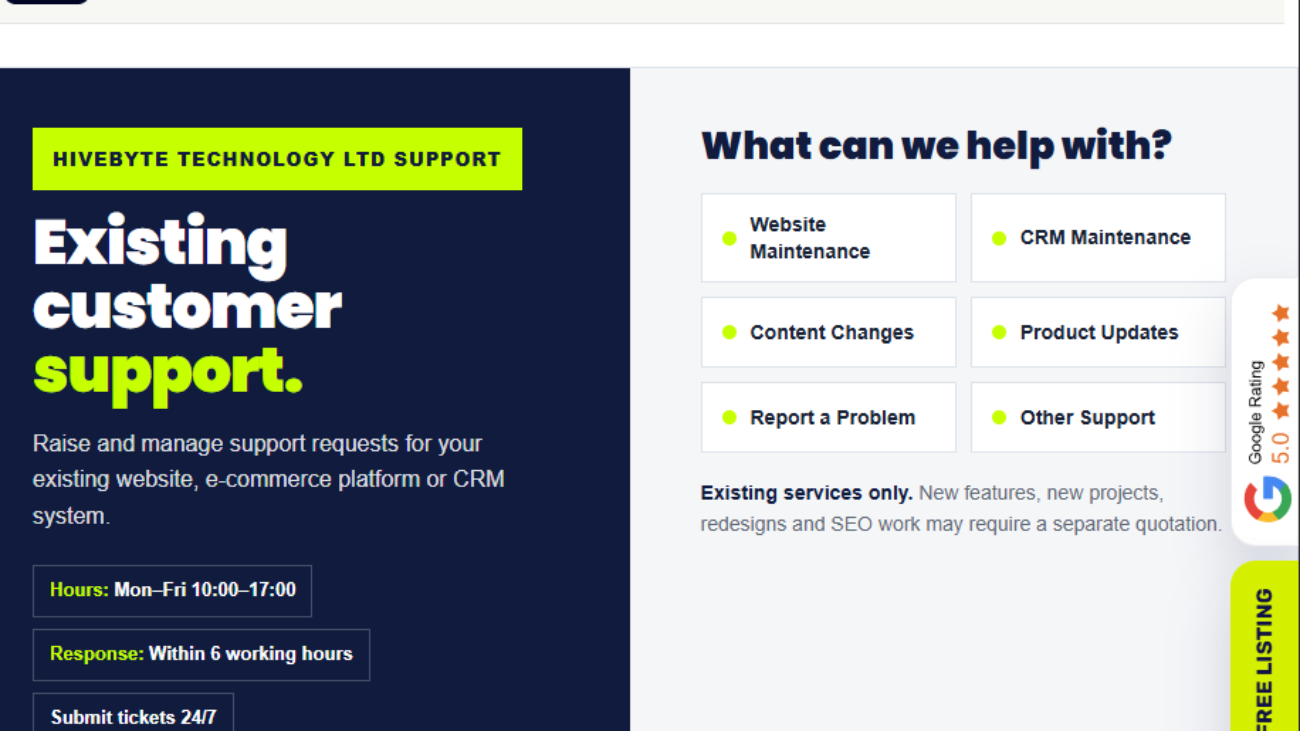
Introducing the New Hivebyte Technology Support Center

Introducing the New Hivebyte Technology Support Center

A Better Support Experience, Built Around Your Journey

At Hivebyte Technology, we believe great technology should be backed by great support.

That’s why we’re excited to announce the launch of the new Hivebyte Technology Support Center — an online destination designed to make getting help simpler, faster, and more focused on your success.

Our new Support Center is more than a place to find answers. It’s part of our commitment to creating a better customer journey, from your first interaction with Hivebyte Technology through implementation, everyday use, support, and long-term success.

Support That Starts With the Customer

Every customer journey is different. Some customers need a quick answer. Others need guidance through a technical challenge, help understanding a service, or support with their next step.

The new Hivebyte Technology Support Center is designed around those different needs.

Customers can use the Support Center to:

  • Find answers to common questions

  • Access helpful guides and support resources

  • Get assistance with technical issues

  • Learn more about Hivebyte Technology services

  • Navigate solutions more easily

  • Connect with our support team when additional help is needed

Our goal is simple: make it easier for customers to get the right support at the right moment.

From Customer Support to Customer Success

We see support as more than solving problems.

Customer success means helping people get lasting value from the technology and services they use. That requires listening to customers, understanding where challenges occur and continually improving the experience.

The new Support Center gives us a stronger foundation for doing exactly that.

As the platform grows, we plan to continue developing resources based on customer questions, feedback and real support experiences. This will help us create a knowledge base that becomes more useful with every stage of the customer journey.

A More Connected Online Experience

The launch of our Support Center is also an important step in the continued development of Hivebyte Technology’s online customer experience.

We want customers to have a clear journey from discovery → onboarding → support → success.

By bringing helpful information and support resources together online, we can reduce unnecessary friction while making it easier for customers to move forward with confidence.

Built to Keep Improving

This is just the beginning.

We’ll continue improving the Hivebyte Technology Support Center with new guides, resources, frequently asked questions and customer-focused content.

Most importantly, we’ll use customer feedback to help shape what comes next.

Because technology may power the solution, but customer success is what gives it purpose.

Welcome to the Hivebyte Technology Support Center

Whether you’re looking for a quick answer, need technical assistance or want to get more from your Hivebyte Technology services, our new Support Center is here to help.

Explore. Learn. Get support. Succeed.

Welcome to a better support journey with Hivebyte Technology.

sss

What If ChatGPT Suddenly Stopped Working in the UK?

Imagine arriving at work tomorrow morning, opening your laptop and discovering that some of the world’s most powerful AI tools are no longer available in Britain.

No warning.

No access.

And no obvious alternative.

For most people, that might sound like a minor inconvenience.

But for thousands of UK businesses that are beginning to build artificial intelligence into their everyday operations, it could be a much bigger problem.

And remarkably, this is now something the UK government is reportedly thinking about.

Why Is the UK Worried About AI Access?

Britain has become an enthusiastic adopter of artificial intelligence.

Companies are using AI to write software, analyse information, process documents, answer customer questions and automate repetitive work.

But there’s a problem.

Many of the most powerful AI models aren’t British.

They are developed by companies overseas.

That means a growing part of Britain’s digital economy could become dependent on technology the UK doesn’t ultimately control.

According to reports this week, the government is examining the economic and security consequences of Britain potentially losing access to leading AI models.

It sounds dramatic.

But it raises a very important question.

Are we becoming too dependent on AI technology controlled by other countries and companies?

AI Has Quietly Become Part of Everyday Business

It wasn’t long ago that ChatGPT felt like an interesting experiment.

People asked it silly questions.

Students discovered it could help with homework.

Businesses experimented with writing emails and social media posts.

Things have moved incredibly quickly since then.

AI is now becoming part of real business infrastructure.

Developers use AI to help write and review code.

Marketing teams use it for research and content.

Customer service teams use AI assistants.

Accountants can use intelligent systems to analyse documents.

Companies are connecting AI directly to websites, CRMs and internal software.

For some businesses, AI isn’t an experiment anymore.

It’s becoming part of how the company operates.

And that’s why losing access would matter.

Imagine Running a Business That Depends on AI

Consider a company that has automated its customer enquiry process.

Someone submits a form through the website.

AI reads the enquiry.

It identifies what the customer needs.

It updates the CRM.

It prepares information for the sales team.

It might even generate a suggested response.

Everything happens automatically.

Now imagine the AI model behind that system suddenly becomes unavailable.

The automation stops.

Staff have to return to doing everything manually.

Customers wait longer.

The business has to find another provider and rebuild parts of its system.

That’s not simply losing access to a chatbot.

That’s losing part of your technology infrastructure.

The UK Has a Technology Dependency Problem

This isn’t unique to artificial intelligence.

Modern businesses already depend heavily on technology controlled by a relatively small number of global companies.

Think about how much of the internet depends on cloud computing.

Or how many businesses depend on Microsoft 365.

Google Workspace.

Amazon Web Services.

Apple and Android smartphones.

Stripe and other payment systems.

Now AI is joining that list.

But AI could become particularly important because it may eventually sit behind hundreds of different business processes.

A company might not even realise how dependent it has become until something stops working.

What Is AI Sovereignty?

You’ll probably hear the phrase AI sovereignty much more over the next few years.

It sounds complicated, but the idea is fairly simple.

A country wants enough control over important artificial intelligence technology that it isn’t completely dependent on somebody else.

That could mean having its own computing infrastructure.

Its own data centres.

Its own AI research.

Its own models.

Its own chips or reliable access to them.

And enough domestic expertise to build and operate these systems.

For Britain, this is becoming both an economic and national security question.

Britain Is Spending Billions on the Problem

The UK isn’t ignoring the issue.

Britain is investing heavily in computing infrastructure and artificial intelligence.

The government has committed significant funding towards AI hardware and domestic capabilities as it attempts to strengthen Britain’s position in the global AI race.

And there’s a good reason for that.

AI is beginning to show up in the wider UK economy.

Recent economic figures showed strong growth in technology industries associated with AI, including computer programming and consultancy.

So the stakes are getting higher.

If AI becomes an important driver of Britain’s economy, reliable access to the technology becomes increasingly important too.

Could Britain Build Its Own ChatGPT?

Technically, Britain has world class researchers, universities and technology companies.

But building AI at the very highest level is enormously expensive.

The biggest models require huge quantities of computing power.

That means enormous data centres filled with specialist chips.

It means electricity.

Engineers.

Researchers.

Training data.

Networking infrastructure.

And billions of pounds in investment.

This is why only a relatively small number of organisations can currently compete at the frontier.

Britain doesn’t necessarily need to recreate every American AI company.

But it may decide that having more domestic capability is strategically important.

This Matters to Small Businesses Too

It’s easy to think this is just a government problem.

It isn’t.

If your business is starting to use AI, you should understand what happens when the technology you’re relying on disappears.

This is the same principle businesses should already apply to websites and cloud software.

Don’t build critical infrastructure with no backup plan.

If an AI provider changes its pricing, changes its rules or removes a service, what happens?

Can you switch providers?

Is your business data portable?

Does your software only work with one AI model?

Could staff temporarily complete the process manually?

These questions sound boring.

Until something stops working.

Then they become extremely important.

The Smart Approach Is Not to Depend on One AI

Businesses don’t need to stop using AI because of this risk.

Quite the opposite.

AI is becoming too useful to ignore.

But companies should think carefully about how their systems are designed.

Where possible, software can be built so that the AI provider isn’t permanently locked into every part of the system.

Think of it like changing your broadband provider.

You don’t want to rebuild your entire office every time you switch.

Good software architecture can make it easier to change technology as the market evolves.

And the AI market is evolving incredibly quickly.

Today’s best model may not be the best model six months from now.

AI Is Becoming Infrastructure

That’s the bigger story here.

Artificial intelligence is beginning to look less like another piece of software and more like infrastructure.

Electricity is infrastructure.

Broadband is infrastructure.

Cloud computing is infrastructure.

AI could eventually sit alongside them.

Businesses may simply expect intelligent systems to be available whenever they’re needed.

Once that happens, who controls the technology becomes incredibly important.

And that is why the UK government is paying attention.

So, Could ChatGPT Really Disappear From Britain?

There’s no indication that ChatGPT is simply about to vanish from UK phones and computers tomorrow.

The point isn’t that people should panic.

The interesting part is that governments are now seriously considering what dependence on foreign AI could mean.

Only a few years ago, that question would have sounded ridiculous.

Today, AI is becoming important enough that access to powerful models can affect businesses, cybersecurity, productivity and potentially an entire country’s economy.

That’s an extraordinary change in a very short period of time.

The Next Technology Race Has Already Started

The internet transformed business because every company eventually needed to become digital.

AI could create a similar shift.

The countries that control the infrastructure, computing power and technology behind artificial intelligence could have a major advantage.

Britain clearly wants to be one of them.

For UK businesses, the lesson is simpler.

Use AI.

Experiment with it.

Automate the things that genuinely waste your time.

But understand what your business is becoming dependent on.

Because the biggest technology story of the next decade may not simply be what AI can do.

It may be who controls it.

About Hivebyte Technology

At Hivebyte Technology, we follow the technology changes that actually matter to UK businesses.

From websites and custom software to CRM systems, automation and emerging technology, we believe the best technology should solve real problems rather than simply follow the latest hype.

And as AI becomes part of everyday business infrastructure, understanding where that technology comes from may become just as important as understanding what it can do.

UK emergency alert

Why Did Your Phone Make That Loud Noise? The UK Emergency Alert Explained

If your phone suddenly started making a loud siren sound yesterday, you weren’t the only one.

Millions of phones across England and Wales received a government emergency alert warning people about the very high risk of wildfires.

For some people it appeared while they were at home. For others it suddenly interrupted conversations, journeys or evenings out.

And because the alert can make a loud siren sound even when your phone is on silent, it’s fair to say it caught quite a few people by surprise.

But how did the government manage to send a message to millions of phones at once?

Did they need your phone number?

Can they track you?

And why did some people receive the alert while others didn’t?

The technology behind it is actually quite interesting.

What Was the UK Emergency Alert About?

The alert was issued because of the exceptionally high wildfire risk across parts of the country.

Britain has been experiencing extreme heat and very dry conditions, creating an environment where even a small fire can quickly become dangerous.

The message warned people not to undertake activities that could accidentally start a fire.

That included things such as disposable barbecues, campfires, firepits, garden incinerators and fireworks.

People were also reminded to report signs of fire immediately.

The warning came as firefighters across the country continued dealing with serious wildfires, some of which have damaged and destroyed homes.

But from a technology perspective, the interesting part was how quickly that warning appeared on millions of devices.

How Did the Government Send a Message to Millions of Phones?

You might assume the government simply sent everyone a giant text message.

That’s not actually how it works.

The UK’s Emergency Alerts system uses technology known as cell broadcasting.

Instead of sending a message to individual telephone numbers, an emergency alert can be broadcast through mobile phone masts in a particular area.

Think of it a little like a radio station.

The mobile mast broadcasts the alert and compatible phones connected within that area can receive it.

This means an alert could potentially be sent across a town, a region or a much larger part of the country.

And it can happen very quickly.

Does the Government Have Your Phone Number?

This is one of the biggest questions people have when an emergency alert suddenly appears.

The answer is that the Emergency Alerts system doesn’t need your phone number to send you the warning.

Because the alert is broadcast through mobile phone infrastructure, the system doesn’t work like an ordinary SMS message sent directly to your number.

Your device receives the broadcast when it is connected to a compatible mobile network in the affected area.

That distinction is important.

The government doesn’t need to create a giant list containing everybody’s mobile number before it can send an emergency warning.

Why Is the Alert So Loud?

The sound is deliberately difficult to ignore.

An emergency warning wouldn’t be particularly useful if it quietly appeared alongside your WhatsApp notifications.

Compatible phones can make a loud siren like noise and vibrate when an alert arrives.

This can happen even when the phone itself is set to silent.

The idea is simple.

If there is a serious danger nearby, authorities want people to notice the warning immediately.

It might be annoying when you’re sitting peacefully at home.

But imagine the alert was warning you about severe flooding, an approaching wildfire or another immediate danger.

Getting everyone’s attention suddenly makes much more sense.

Why Didn’t Some People Receive the Emergency Alert?

Interestingly, while millions of phones received the warning, some people reported receiving nothing.

There can be several reasons for this.

Your phone needs to be compatible with the Emergency Alerts system and connected to a supported mobile network.

A device might also miss an alert if it is switched off or in airplane mode when the warning is broadcast.

Network conditions and device settings can also play a role.

This explains why two people sitting near each other can sometimes have completely different experiences.

One phone starts screaming.

The other does absolutely nothing.

Can Emergency Alerts Track Your Location?

The system works differently from an app constantly monitoring your GPS position.

Emergency Alerts can be targeted geographically using mobile network infrastructure.

The alert is broadcast to compatible devices connected to mobile masts covering the relevant area.

That means authorities can warn people in an affected location without needing to know the identity of every person receiving the message.

This is one of the clever aspects of cell broadcast technology.

The network effectively says:

“Every compatible phone in this area needs to see this warning.”

It doesn’t need to individually message every person.

Why Not Just Send Everyone a Text?

Imagine trying to send an SMS to tens of millions of people during an emergency.

That’s an enormous number of individual messages.

Cell broadcasting is designed for exactly this type of situation.

One message can be transmitted to large numbers of compatible devices within an area at the same time.

It’s also useful because emergency warnings can be geographically targeted.

A serious flood in one part of Britain doesn’t necessarily require disturbing everybody in Scotland, Wales and England.

Authorities can target warnings towards the people who actually need the information.

Your Smartphone Is Becoming Part of Britain’s Emergency Infrastructure

This is perhaps the most interesting part of the story.

Most of us think of our phones as personal devices.

We use them for TikTok.

WhatsApp.

Banking.

Google Maps.

Taking photos.

Checking emails.

Ordering food.

But smartphones have quietly become part of national infrastructure too.

Almost everybody carries one.

They’re connected to mobile networks throughout the day.

And they can receive information almost instantly.

That makes smartphones an incredibly powerful tool during an emergency.

Instead of waiting for someone to see a television broadcast, hear something on the radio or notice a post on social media, an important warning can appear directly on the device sitting in their pocket.

What Happens During a Bigger Emergency?

The technology isn’t limited to wildfire warnings.

The UK Emergency Alerts system can potentially be used when there is a serious threat to life.

That could include situations involving severe flooding, extreme weather or other major emergencies.

And because alerts can be geographically targeted, the message people receive can relate directly to what’s happening around them.

Imagine a rapidly developing flood.

People within the affected area could receive instructions telling them what is happening and what action they need to take.

In situations where every minute matters, that could be incredibly valuable.

Technology You Hopefully Never Need

Most technology is designed to make life easier.

Emergency technology is slightly different.

The best outcome is that you rarely need it.

But when something serious happens, the infrastructure needs to already exist.

Mobile networks, smartphones and cell broadcasting have created a way of communicating with millions of people extremely quickly.

Yesterday’s alert gave millions of people a very noticeable demonstration of that technology.

For many, the first reaction was probably:

“Why is my phone making that noise?”

But behind that loud siren is a surprisingly clever communication system.

Your phone number isn’t required.

You don’t need to download a special app.

And the warning can reach huge numbers of people in seconds.

It’s a good example of technology doing something that isn’t particularly glamorous but could ultimately help save lives.

So the next time your phone suddenly starts making a noise you’ve never heard before, don’t immediately throw it across the room.

Take a look at the screen.

It might actually be important.

About Hivebyte Technology

At Hivebyte Technology, we love looking beyond the headline to understand how the technology around us actually works.

From websites and custom software to mobile technology, automation and emerging digital trends, we’ll continue covering the technology stories affecting people and businesses across the UK.