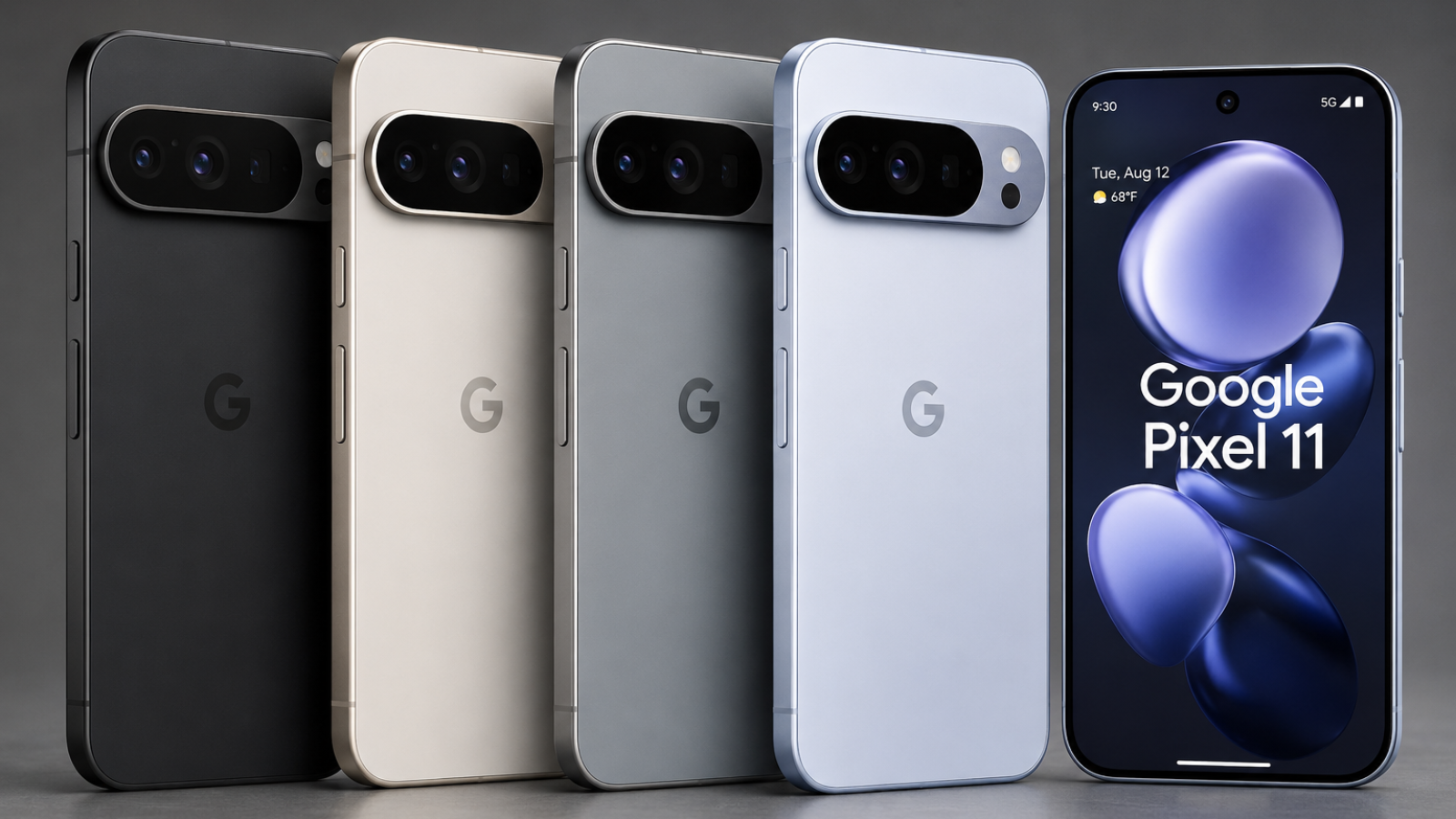
Google has revealed the new Pixel 11, and this year the most interesting part isn’t the camera, the screen or even the new processor.
It’s AI.
For years, buying a new smartphone was fairly predictable. You got a better camera, a faster processor, a brighter display and hopefully a battery that lasted a little longer.
The Pixel 11 feels different.
Google is trying to turn the smartphone from something that simply runs apps into something that actually understands what you’re trying to do.
And Gemini is at the centre of it.
Meet the Google Pixel 11
The new Pixel family includes the Pixel 11, Pixel 11 Pro, Pixel 11 Pro XL and Pixel 11 Pro Fold.
On paper, there are plenty of upgrades you’d expect from a new generation of Pixel phones. Better cameras, improved performance and Google’s latest Tensor G6 processor are all here.
But specs only tell part of the story.
Google has spent years developing Gemini, and we’re now starting to see why owning both the software and the hardware matters so much.
Google doesn’t just want you to open Gemini when you have a question.
It wants Gemini to become part of how you use your phone.
Your Phone Is Starting to Understand You
Think about how we use smartphones today.
You open Google Maps to find somewhere.
You open your calendar to check when you’re free.
You open your email to find a booking.
You open a browser to research something.
You open another app to message somebody.
Every task requires us to decide which app we need, find it and then do the work ourselves.
AI could completely change that.
Instead of jumping between five different apps, imagine simply telling your phone what you want to achieve.
You might say:
“Find the hotel confirmation in my email, tell me what time I need to leave tomorrow and show me the quickest route.”
Your phone already has access to many of the tools needed to answer that question.
What’s been missing is the intelligence capable of connecting everything together.
That’s where Gemini becomes interesting.
The Pixel Camera Is Becoming More About Software
Google has always taken a slightly different approach to smartphone cameras.
While other manufacturers competed over megapixels and increasingly large camera sensors, Google became known for computational photography.
In simple terms, the software processing the photo became almost as important as the camera taking it.
AI takes that idea much further.
The Pixel 11 generation brings upgraded camera technology alongside intelligent photography features that can help understand and process what you’re capturing.
And that raises an interesting question.
When we compare smartphone cameras in a few years, will we even care as much about the physical camera?
Or will we care more about what the AI behind it can do?
A great smartphone camera may eventually be defined by how well it understands the scene in front of it rather than simply how many megapixels it has.
Then There’s Google’s New Tensor G6
Hidden inside the Pixel 11 is perhaps one of its most important upgrades.
Google’s new Tensor G6 processor.
Processors aren’t particularly exciting to most people. Nobody sits in the pub discussing neural processing units.
But Tensor is important because Google isn’t designing these chips purely to make apps open slightly faster.
It’s designing them with AI in mind.
Some artificial intelligence tasks can now happen directly on the phone rather than sending everything to huge computers sitting inside a data centre.
That can mean faster responses and more useful features.
It can also potentially mean greater privacy because certain information can be processed locally.
Your phone is slowly becoming powerful enough to run forms of artificial intelligence that would once have required enormous computing resources.
That’s quite remarkable when you think about it.
We Could Be Moving Beyond Apps
Here’s where things get really interesting.
For nearly two decades, apps have defined smartphones.
Need a taxi? Open an app.
Want food? Open an app.
Need directions? Open an app.
Want to book a hotel? Open another app.
AI agents could eventually change this behaviour.
Instead of choosing which application to use, you simply tell your phone what you want.
Imagine saying:
“Find me a highly rated Italian restaurant near my hotel tomorrow night, make sure it has vegetarian options and find me a table for two at around 7pm.”
Today you’d probably use Google, Maps, restaurant websites and perhaps a booking platform to complete that task.
In the future, your AI assistant could potentially handle much of that work for you.
That’s a much bigger change than adding another chatbot to your phone.
Google Has a Huge Advantage
There’s another reason the Pixel 11 is worth watching.
Google owns an extraordinary amount of the technology needed to build this future.
It has Android.
It has Google Search.
It has Maps.
It has Gmail.
It has YouTube.
It has Google Cloud.
It has Gemini.
And now it has increasingly powerful AI focused Tensor processors inside its own phones.
When all of those pieces begin working together, the possibilities become much bigger.
Google isn’t simply trying to build a better smartphone.
It’s trying to build an intelligent ecosystem around you.
Apple and Samsung Won’t Be Watching Quietly
Of course, Google isn’t alone.
Apple, Samsung and practically every major technology company are investing heavily in artificial intelligence.
That means the old smartphone battle could be about to change.
For years, people argued about who had the better camera, better display or better operating system.
The next argument might be much simpler.
Who has the best AI assistant?
And more importantly:
Which AI actually saves you time?
Nobody wants 200 AI features they’ll never use.
The companies that succeed will probably be the ones that make AI almost invisible.
You ask for something.
Your phone understands.
It gets it done.
That’s when AI becomes genuinely useful.
This Matters to Businesses Too
You might be wondering what any of this has to do with businesses in the UK.
Potentially quite a lot.
Think about how people currently discover companies.
Someone looking for a website developer might search Google for:
“web design company Manchester”
They’ll see search results, visit several websites, read reviews and eventually contact a few companies.
AI assistants could change that journey.
Instead, someone could ask:
“Find me three web development companies in Manchester that build bespoke websites, have good reviews and can integrate a CRM.”
The AI could potentially do much of the research for them.
That changes the challenge for businesses.
Your website won’t only need to convince people.
Increasingly, it may also need to give AI systems enough reliable information to understand who you are, what you do and why they should recommend you.
That’s going to make good websites, useful content, strong branding and clear information even more important.
So, Is the Pixel 11 Actually a Big Deal?
Maybe not because of the phone itself.
Next year there will be another Pixel.
There will be another iPhone.
There will be another Galaxy.
The bigger story is what’s happening underneath all of them.
We’re watching smartphones slowly transform from devices that wait for instructions into devices that can understand context.
Right now, AI still feels like something you deliberately use.
You open ChatGPT.
You open Gemini.
You type a question.
You wait for an answer.
That won’t necessarily be how AI works forever.
Eventually, artificial intelligence may simply become part of the technology around us.
Your phone will understand it.
Your car will understand it.
Your website will use it.
Your business software will use it.
And eventually we might stop talking about “AI features” altogether because they’ll simply be normal features.
That’s why the Google Pixel 11 is interesting.
It’s not just another new phone.
It’s another glimpse at what our phones are becoming.
And the future looks a lot less like opening apps and a lot more like simply asking for what you want.
Hivebyte Technology
We build websites, custom software and digital solutions for businesses that want to make better use of modern technology.
As AI continues to change how people search, work and interact with businesses online, we’ll be following the technology that actually matters and explaining what it means without the jargon.